
Feldspar – The Mineral Family That Plays With Light
Earth’s Hidden Treasures Journal
Approx. reading time: 12 minutes
In This Article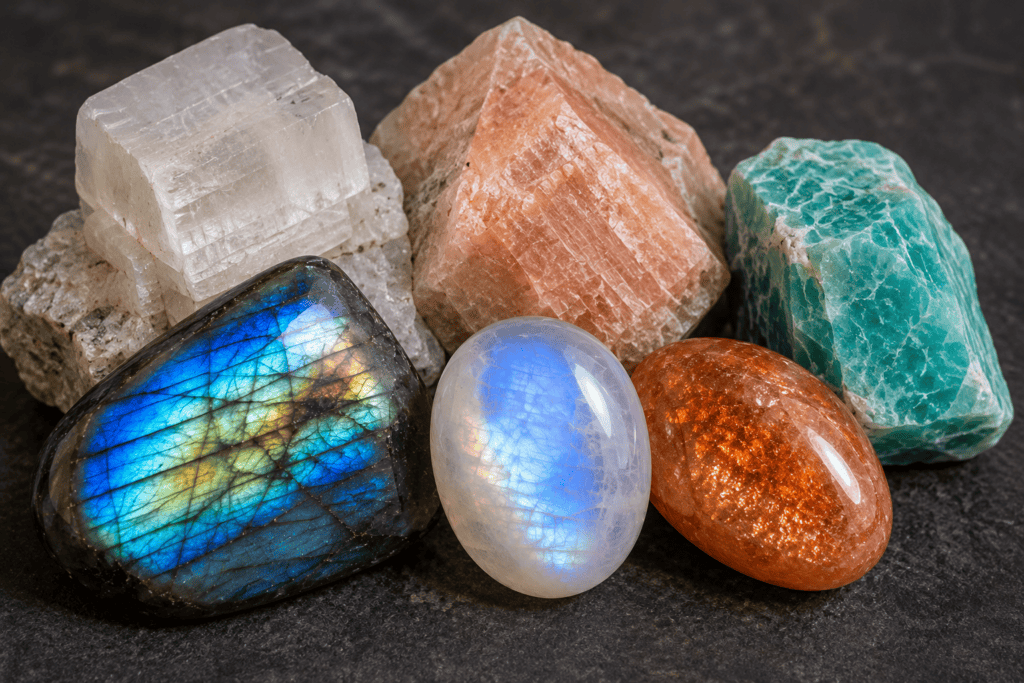
- What Is Feldspar?
- The Feldspar Family Tree
- When Feldspar Plays With Light
- Is Rainbow Moonstone Really Moonstone?
- Amazonite – The Colourful Cousin
- When Feldspar Becomes Clay
- Feldspar in Everyday Life
- Where Is Feldspar Found?
- One Family, Many Surprises
- Quick Facts
- Further Reading
Topics Covered: Mineralogy • Geology • Gemstones • Optical Effects • Earth Science
~
Moonstone seems to glow from within.
Turn a piece of Labradorite in your hand and brilliant flashes of blue, green, gold — and sometimes almost every colour of the rainbow — can suddenly appear across its surface.
Sunstone does something different again, sparkling as tiny reflective inclusions catch the light.
At first glance, these three gemstones seem to have very little in common.
But they are all members of the same extraordinary mineral family:
Feldspar.
And that family is much bigger than the gemstones we recognise in crystal shops.
Feldspars are among the great building blocks of our planet, making up an estimated 60% of the Earth’s crust. They occur in familiar rocks such as granite and are found in geological environments all over the world.
Yet some members of this incredibly common mineral family have developed remarkable ways of interacting with light.
Moonstone has its soft floating glow, known as adularescence.
Labradorite produces the dramatic flashes known as labradorescence.
And Sunstone can sparkle with aventurescence.
These aren’t simply three different names for the same effect. Each has its own geological explanation — tiny structures and inclusions hidden inside the stone changing what happens when light enters it.
And Feldspar still has a few more surprises waiting for us.
Because once we start exploring this enormous mineral family, we also meet Amazonite, discover why something sold as Rainbow Moonstone isn’t actually Moonstone in the mineralogical sense, and find out why the Feldspar beneath our feet can be every bit as interesting as the gemstones in our cabinets.
So how can one of the most abundant mineral families on Earth produce gemstones famous for some of nature’s most beautiful displays of light?
That’s where our Feldspar story begins.
What Is Feldspar?
Feldspar isn’t actually one mineral.
It’s the name given to a large family of closely related minerals that share a similar crystal structure but vary in their chemistry. And although names such as Moonstone and Labradorite may be more familiar to us, Feldspar itself is anything but unusual.
In fact, feldspars are the most abundant group of minerals in the Earth’s crust. They are major ingredients in many of the rocks around us, including granite, and play an enormous role in the geology of our planet.
At the heart of the family are aluminium, silicon and oxygen, joined by varying amounts of elements such as potassium, sodium and calcium.
Those differences allow geologists to divide most of the Feldspar family into two broad branches.
The Feldspar Family Tree
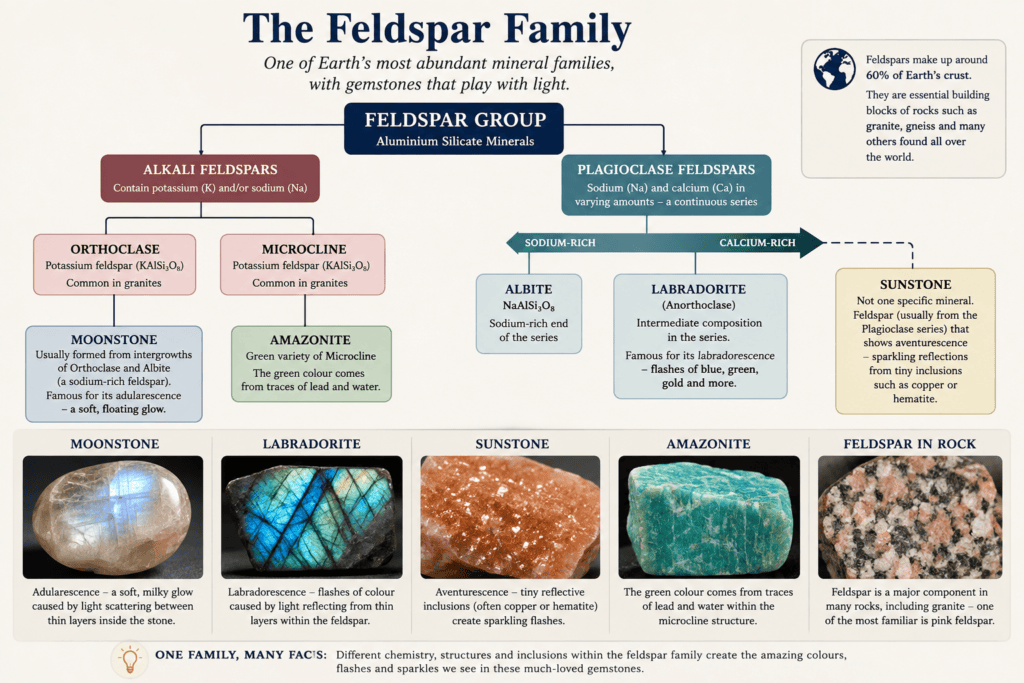
Alkali Feldspars contain mainly potassium and sodium.
This side of the family includes minerals such as Orthoclase and Microcline. Beautiful green Amazonite is a variety of Microcline, while traditional Moonstone is commonly associated with inter-growths involving Orthoclase and sodium-rich Feldspar.
Then we have the Plagioclase Feldspars.
Instead of one fixed recipe, Plagioclase forms a series in which the proportions of sodium and calcium gradually change. At one end is sodium-rich Albite, while calcium becomes increasingly important as we travel through the series. Labradorite belongs to this branch of the family.
And Sunstone?
That’s where things get particularly interesting.
Sunstone isn’t a single Feldspar mineral at all. The name describes Feldspar that displays a sparkling optical effect, and different types of Feldspar can produce it.
So already our family tree looks rather different from what we might expect:
Moonstone • Labradorite • Sunstone • Amazonite
They can look completely unrelated in a crystal shop, yet all lead us back to Feldspar.
Fortunately, we don’t need to memorise the entire Feldspar family tree to appreciate it.
What’s much more interesting is what happens when light meets some of these minerals.
Because that’s when an incredibly common group of rock-forming minerals becomes something rather spectacular.
When Feldspar Plays With Light
Pick up a piece of Moonstone, Labradorite and Sunstone and move each one beneath a light.
All three can suddenly come alive.
Moonstone seems to develop a soft glow beneath its surface. Labradorite can erupt into brilliant flashes of blue, green, gold and other colours. Sunstone can glitter as though tiny metallic sparks have been trapped inside it.
They’re all Feldspars.
But remarkably, they aren’t all doing the same thing.
The effects have different names — and different explanations.
Moonstone – The Glow
Moonstone is famous for adularescence.
Rather than simply reflecting from the surface, light enters the stone and interacts with incredibly thin layers of Feldspar inside it. The light is scattered, creating that characteristic soft glow which seems to float or move beneath the surface as the stone is turned.
It’s this movement that gives good Moonstone its almost watery appearance — as though the light is coming from somewhere inside the stone.
Labradorite – The Flash
Labradorite is far more dramatic.
At first it can appear grey, dark or rather unremarkable. Then you turn it towards the light and suddenly a brilliant patch of blue, green, gold, orange or even violet appears.
This is labradorescence.
Again, extremely thin structures inside the Feldspar are responsible. Light interacting with these internal layers produces the shifting colours we see when the stone is viewed from different angles.
So the spectacular colour isn’t simply sitting on the surface of the Labradorite.
The structure inside the mineral is creating the display.
Sunstone – The Sparkle
And then Sunstone has another trick entirely.
Its characteristic glitter is known as aventurescence.
This time, tiny flat reflective inclusions within the Feldspar act rather like microscopic mirrors. When light catches them at the right angle, they produce the bright metallic-looking sparkles associated with Sunstone.
Depending on the particular Sunstone, those inclusions can include minerals such as copper or hematite.
So three gemstones from the Feldspar family give us three very different performances:
Moonstone glows.
Labradorite flashes.
Sunstone sparkles.
And all of it happens because of something hidden inside the stone.
Which makes Feldspar rather more exciting than the phrase “common rock-forming mineral” might suggest. 😁
~
Is Rainbow Moonstone Really Moonstone?
Despite its name, Rainbow Moonstone isn’t technically Moonstone at all.
It is actually a light-coloured variety of Labradorite — which means it belongs to the plagioclase side of the Feldspar family rather than the alkali Feldspars traditionally associated with Moonstone. The name Rainbow Moonstone has become widely accepted within the gem trade, but mineralogically it’s Labradorite.
And this explains why Rainbow Moonstone can look so different from traditional Moonstone.
Classic Moonstone is famous for its soft, floating white or blue glow. Rainbow Moonstone can produce much stronger flashes of blue and sometimes a whole spectrum of colours — exactly the sort of dramatic behaviour we associate with Labradorite.
So if you’ve ever looked at a piece of Rainbow Moonstone and thought:
“That looks suspiciously like white Labradorite…”
You’d be absolutely right. 😁
The name is a wonderful example of the difference between a trade name and a mineralogical identity. Neither stone is somehow more genuine than the other — they’re both members of the Feldspar family — but they’re not quite the same thing.
And that’s something worth knowing when we’re buying, collecting or simply trying to understand the crystals in front of us.
Amazonite – The Colourful Cousin
While Moonstone glows, Labradorite flashes and Sunstone sparkles, Amazonite has a rather different way of attracting attention.
It is simply an extraordinary colour.
Amazonite ranges from soft green and blue-green through to wonderfully vivid turquoise shades, often broken by white streaks or patterns. Yet underneath all that colour is Microcline — one of the potassium-rich Feldspars we met earlier.
For a long time, the cause of Amazonite’s distinctive colour wasn’t completely understood.
We now know that tiny amounts of lead play an important role, together with water held within the crystal structure and natural irradiation. It’s a wonderful example of how incredibly small changes inside an otherwise familiar mineral can completely transform its appearance.
But Did Amazonite Come From the Amazon?
Despite its name, Amazonite doesn’t have a straightforward connection with the Amazon River.
The mineral was named Amazonite in 1847, after reports of green stones associated with the Amazon region. But there is uncertainty over whether those stones were actually the mineral we now call Amazonite.
So we have a gemstone named after a place where it may not actually have been found.
Mineral names are wonderfully unhelpful sometimes. 😂
Beautiful Amazonite is now found in several parts of the world, including Madagascar, which is an important source of much of the material seen in the crystal trade today. Other notable localities include Colorado in the USA, famous for spectacular Amazonite crystal specimens, as well as Ethiopia and several other countries.
And Amazonite gives us another reminder of just how varied the Feldspar family can be.
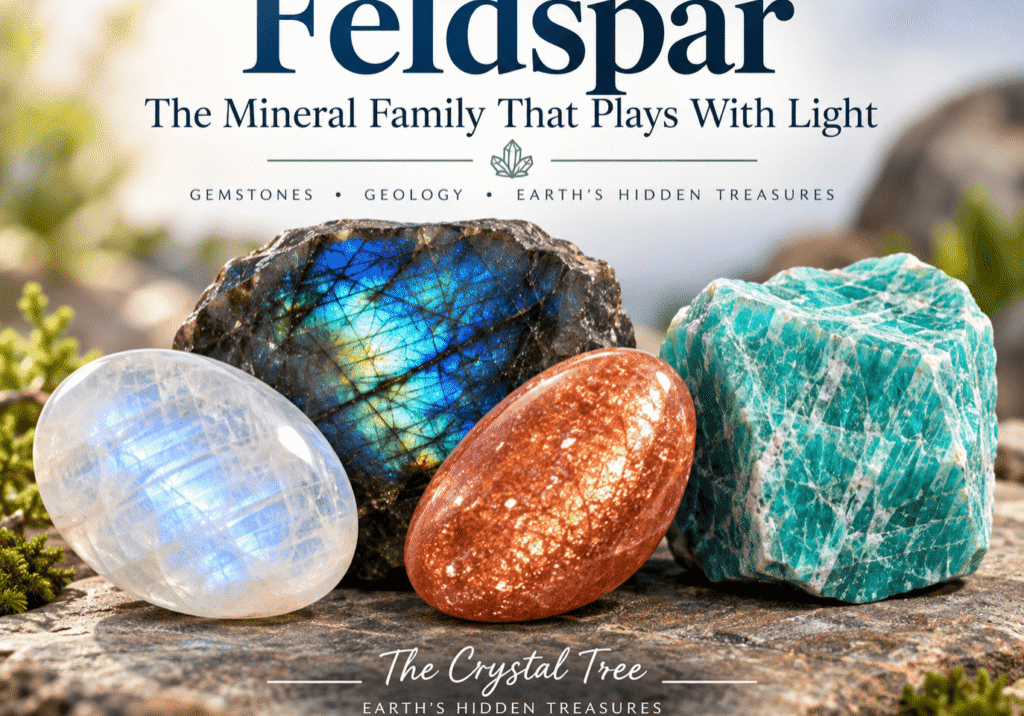
Put turquoise-green Amazonite beside shimmering Moonstone, dark Labradorite and sparkling Sunstone and you’d be forgiven for thinking you were looking at four completely unrelated minerals.
Yet once again, beneath those very different appearances…
it’s all in the family.
When Feldspar Becomes Clay
Feldspar may be one of the most abundant mineral families in the Earth’s crust, but once it reaches the surface, it doesn’t necessarily stay Feldspar forever.
Rainwater, air and time gradually begin to alter it.
Water reacts with the Feldspar in rocks such as granite, slowly breaking down its crystal structure. Over long periods, some of that Feldspar can be transformed into entirely new minerals — including clay minerals such as kaolinite.
So something rather ordinary beneath our feet has an unexpected connection:
Feldspar is one of the important geological starting materials from which clay can form.
That means the mineral family responsible for shimmering Moonstone, flashing Labradorite and sparkling Sunstone is also involved in creating something as familiar as the clay found in soils and sediments.
And humans eventually found plenty of uses for that too.
Kaolinite became the essential ingredient in porcelain and ceramics, while Feldspar itself is still widely used in the manufacture of glass and ceramics.
It’s quite a journey for one mineral family:
From molten rock…
to crystals…
to gemstones…
and eventually, sometimes, to clay.
Not bad for something most people have never even heard of. 😂

Feldspar in Everyday Life
You may never have knowingly bought a piece of ordinary Feldspar, but there’s a very good chance you’re surrounded by it.
Beyond the gemstone world, Feldspar is an important industrial mineral, particularly in the manufacture of glass and ceramics.
In ceramics, finely ground Feldspar acts as a flux. In simple terms, it helps the other ingredients melt and fuse together at a lower temperature during firing, contributing to the hard, glassy finished material. That’s why Feldspar can be found in products such as ceramic tiles, pottery and sanitary ware.
It also has an important job in glassmaking. Feldspar supplies aluminium to the mixture, helping to improve the glass’s hardness, durability and resistance to chemical attack.
So there could be Feldspar involved in the window you’re looking through, the tiles beneath your feet, or the ceramic mug you’re drinking from.
Which gives this mineral family a rather extraordinary double life.
We admire some Feldspars because Moonstone glows, Labradorite flashes, Sunstone sparkles and Amazonite produces those beautiful blue-green colours.
Meanwhile, enormous quantities of less glamorous Feldspar quietly help us make the objects and materials we use every day.
From gemstone cabinets to bathroom tiles — Feldspar gets around. 😂
Where Is Feldspar Found?
Considering Feldspar makes up such a large proportion of the Earth’s crust, the simple answer would be:
Almost everywhere.
But gemstone-quality Feldspar is another matter entirely.
Some places around the world have become particularly associated with the colourful, glowing and sparkling members of the family.
Madagascar – A Feldspar Treasure House
Madagascar deserves a special mention because it produces several beautiful members of the Feldspar family.
It is an important source of Amazonite, including material from numerous pegmatite deposits across the island. Madagascar’s pegmatites have produced Amazonite for well over a century, and today Madagascar is one of the countries most strongly associated with the material we encounter in the crystal trade.
Madagascar is also famous for the pale Feldspar commonly sold as Rainbow Moonstone — the Labradorite variety we met earlier.
So two stones sitting beside one another in a crystal shop — turquoise Amazonite and shimmering Rainbow Moonstone — may both have begun their journeys in Madagascar.
Sri Lanka – The Home of Fine Moonstone
Sri Lanka has a long association with beautiful Moonstone, particularly material displaying a blue or silvery adularescence.
One especially famous locality is Meetiyagoda, in the south of the island. Here Moonstone occurs in deeply weathered Feldspar pegmatite — which gives us a lovely connection back to something we’ve already discovered: Feldspar’s tendency to break down and alter into clay minerals. The deposit itself is strongly kaolinised.
Suddenly our clay diversion doesn’t seem like such a diversion after all. 😁
Labrador – The Stone That Took Its Name Home
Labradorite has perhaps the easiest locality to remember.
It was named after Labrador in Canada, where spectacular iridescent Feldspar was encountered by Europeans in the eighteenth century.
Labradorite has since been found in many other parts of the world — notably Madagascar and Finland — but its Canadian birthplace remains preserved in its name.
Oregon – Sunstone With Copper Inside
In the high desert of Oregon in the USA, something particularly beautiful occurs.
Oregon Sunstone is copper-bearing Labradorite Feldspar.
Tiny copper inclusions can create its characteristic glitter, while exceptional stones may display rich reds, greens and combinations of colours. Oregon Sunstone became the state’s official gemstone in 1987.
And that’s perhaps the wonderful thing about Feldspar.
The family itself is extraordinarily common.
But occasionally, the right chemistry, the right geological conditions and a little geological luck transform one of Earth’s most ordinary rock-forming minerals into something quite extraordinary.
One Family, Many Surprises
Feldspar might not be a name that immediately excites the average crystal collector.
Moonstone, Labradorite, Sunstone and Amazonite, on the other hand, are another matter entirely.
And perhaps that’s what makes this mineral family so fascinating.
One branch gives us the floating glow of Moonstone. Another produces Labradorite’s extraordinary flashes. Tiny reflective inclusions make Sunstone sparkle, while subtle changes within Microcline create the unmistakable blue-green of Amazonite.
But Feldspar’s story turned out to be much bigger than gemstones.
It’s one of the great building blocks of our planet. It hides in ordinary rocks, helps us make glass and ceramics and, given enough water and geological time, can even break down and contribute to the formation of clay.
And I think that’s the part of the story I like most.
Something can be so common that we barely notice it, yet still be responsible for some of the most beautiful optical effects in the mineral world.
Moonstone glows.
Labradorite flashes.
Sunstone sparkles.
Amazonite brings the colour.
And beneath them all is a mineral family most people have probably never given a second thought.
Feldspar really does play with light — but that’s only one of its surprises.
Quick Facts
Mineral group: Feldspar
What is it? A large family of aluminium silicate minerals
Main elements: Aluminium, silicon and oxygen, with varying amounts of potassium, sodium and calcium
Main branches: Alkali Feldspar and Plagioclase Feldspar
Hardness: Around 6 on the Mohs scale, although individual Feldspars vary
Common colours: White, cream, grey, pink, green, blue-green, yellow, orange and red
Famous gemstone members: Moonstone, Labradorite, Sunstone and Amazonite
Famous optical effects: Adularescence in Moonstone, labradorescence in Labradorite and aventurescence in Sunstone
How common is it? Feldspars make up more than half of the Earth’s rocky crust
Found in: Many igneous, metamorphic and sedimentary rocks
Also used for: Glass and ceramics
And eventually…: Weathering of Feldspar can contribute to the formation of clay minerals — one of our favourite discoveries from this Journal!
Further Reading
If you’d like to explore the Feldspar family in more detail, these are excellent places to continue:
Mindat – Feldspar Group — for the serious mineralogy, individual Feldspar species and locality information.
GIA – Moonstone — particularly good for understanding Moonstone and adularescence.
GIA – Sunstone — Sunstone, aventurescence and the fascinating copper-bearing Oregon material.
USGS – Feldspar Statistics and Information — useful for Feldspar’s industrial story and its importance in glass and ceramics.
Continue Exploring Earth’s Hidden Treasures
Feldspar is just one of the extraordinary mineral families hiding behind many of the crystals we recognise.
Visit our Crystal Library to discover more about the geology, formation and stories behind Earth’s hidden treasures.
Here some others blog posts for you

Birthstones – Who Decided Which Stone Belongs to Each Month?
Celebrating International Rock Day: The Stories Hidden in Stone
