
New Stock Spotlight – 10 Fascinating Crystals & Minerals
New Stock Spotlight – 10 Fascinating Crystals & Minerals
There is something particularly exciting about unpacking new stock at The Crystal Tree. Even after all these years, we still find ourselves stopping to admire an unusual formation, an unexpected colour or a mineral we haven’t seen for a while.
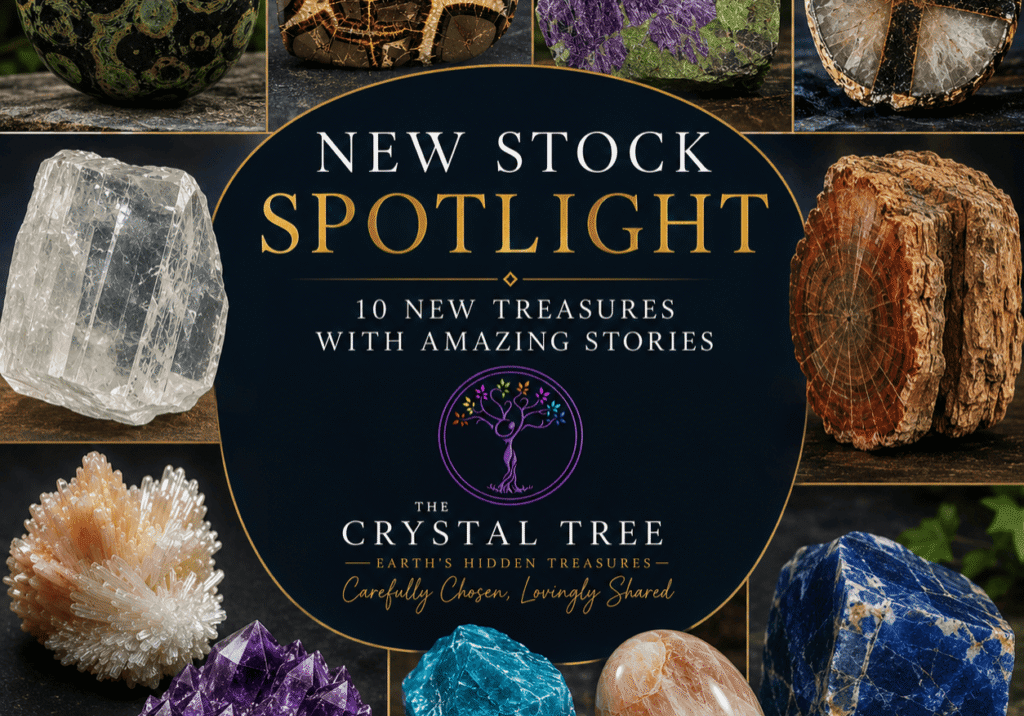
This particular collection brought together ten very different crystals and minerals, from the familiar beauty of Amethyst to some rather more unusual geological treasures.
This article originally began life as a preview of one of our Facebook Live shows in May 2026, when we shared some of the new treasures arriving at The Crystal Tree. The Live may now be part of our history, but the crystals certainly aren’t! There was so much interesting information hidden within the original post that we decided it deserved to stay — with a little reworking.
So, rather than letting these fascinating pieces disappear into an old stock announcement, we’re taking another look at what made each of them worth talking about in the first place.
Some have remarkable geological stories. Others have fascinating histories or unusual ways of forming. And a few may be completely new to you.
Let’s explore them.
Nigerian Amethyst – Tutu Cliffs
These striking Amethyst points come from the Tutu Cliffs area of Nigeria and immediately caught our attention for their deep, rich purple colour and beautiful clarity.
Amethyst is a variety of quartz. Its purple colour develops through a combination of trace amounts of iron within the quartz and natural irradiation over geological time. While Amethyst can range from the palest lilac to an intense violet, material from Nigeria can produce particularly rich, saturated purple crystals.

But colour isn’t the only interesting thing about the pieces we have at The Crystal Tree.
Hold some of them up to the light and you can see phantoms hidden inside.
A phantom records an earlier stage in the crystal’s growth. At some point, growth slowed or stopped and another mineral or material settled onto the crystal’s surface. When the quartz began growing again, it enclosed that earlier outline within the new crystal.
It’s rather like seeing a snapshot of the crystal at an earlier moment in its life — preserved inside the crystal we see today.
Our Nigerian Amethyst pieces show these internal growth patterns beautifully, making them fascinating specimens to examine as well as lovely examples of Amethyst.
Preseli Bluestone
Preseli Bluestone has one of the most fascinating connections between geology and human history.
The name is commonly used for spotted dolerite from the Preseli Hills in west Wales. Dolerite is an igneous rock, formed when molten rock cooled and crystallised beneath the Earth’s surface. The distinctive pale spots visible in some pieces are mineral crystals that developed within the rock.
What makes Preseli Bluestone particularly special is its connection to Stonehenge.
Geological studies have matched some of Stonehenge’s famous bluestones — including spotted dolerite — to rock sources in the Preseli area of Wales, more than 100 miles from Stonehenge. Exactly how these enormous stones made that journey thousands of years ago is still a fascinating subject of archaeological research and debate.
When you hold a piece of Preseli Bluestone, you’re therefore holding more than an interesting British rock. You’re holding a type of stone whose geological fingerprint has helped researchers unravel part of the extraordinary story of Stonehenge.
Kambaba Jasper
Kambaba Jasper is a wonderful example of why trade names don’t always tell us the whole geological story.
Despite being sold around the world as a type of jasper, Kambaba Jasper from Madagascar is generally described geologically as a volcanic rock, rather than a true jasper. Its distinctive green and black swirls and rounded patterns give every polished piece an almost otherworldly appearance.
You may also have heard that those patterns are fossilised stromatolites — ancient structures created by colonies of microorganisms. It’s a lovely story and one that has been repeated widely within the crystal trade, but the geological evidence doesn’t support it.
The patterns are mineralogical rather than fossilised life.
We actually think that makes Kambaba Jasper more interesting, not less. It’s a perfect example of how a story can become attached to a stone, be repeated for years, and eventually become accepted as fact.
Sometimes taking a closer look at the geology reveals an entirely different story — and that’s part of the fun of learning about the treasures beneath our feet.
Septarian
Septarian is one of those stones where the pattern gives us a glimpse into what was happening beneath an ancient seabed millions of years ago.
These distinctive nodules began forming within soft, mineral-rich sediment. As the sediment hardened and changed, cracks developed inside the nodules. Over time, mineral-rich fluids travelled through those spaces and deposited minerals such as calcite, gradually filling the fractures.
When a Septarian nodule is cut and polished, that hidden network is revealed — dark rock divided by striking cream, yellow or brown mineral-filled veins.
They’re sometimes nicknamed “Dragon Stone” or “Dragon Egg” because the cracked patterns resemble scales, but the real explanation is entirely geological.
What you’re looking at is a record of sediment, cracking, mineral-rich fluids and an enormous amount of time — all preserved inside one remarkable nodule.
Atlantisite
Atlantisite is one of those wonderful stones where two very different colours — and minerals — meet in the same rock.
The name Atlantisite is a trade name for material containing purple stichtite within green serpentine, most famously associated with Tasmania, Australia. Stichtite itself is a relatively uncommon magnesium- and chromium-rich mineral, and its lilac to purple colour creates a beautiful contrast against the surrounding green serpentine.
The story behind those colours begins with rocks originally rich in magnesium and iron. Over geological time, heat, pressure and circulating fluids altered the original rock, allowing new minerals to form — including the serpentine and stichtite we see today.
The romantic name Atlantisite may suggest lost worlds and ancient mysteries, but its real story is one of geological transformation.
And for us, that’s every bit as interesting. Check out our Atlantisite sphere here.
Chiastolite (Cross Stone)
At first glance, Chiastolite can look almost too perfectly patterned to be natural.
Chiastolite is a distinctive variety of andalusite, best known for the dark cross that appears when the crystal is cut across its length. This remarkable pattern forms naturally as the crystal grows, trapping dark carbon-rich material — traditionally described as graphite — within particular areas of the developing crystal.
The result is the characteristic cross-shaped pattern that gave Chiastolite its traditional name, “Cross Stone.”
No two crosses are exactly alike. Some are beautifully defined, while others appear softer or more irregular depending on how the crystal grew and how it was cut.
It’s a wonderful example of something we particularly love about geology: sometimes nature creates patterns that look almost deliberately designed, when what we’re really seeing is a record of how a crystal grew.
Cryolite
Cryolite is an unusual mineral with a surprisingly important place in industrial history.
This pale, often translucent mineral is a sodium aluminium fluoride. Its name comes from Greek words meaning “frost stone” or “ice stone”, inspired by its icy appearance.
The most famous deposit was found at Ivittuut in Greenland, where Cryolite was mined commercially for more than a century. It became particularly valuable because it was used in the production of aluminium, helping to lower the temperature needed during the smelting process.
The natural deposit at Ivittuut was eventually exhausted and the mine closed in the 1980s. Today, synthetic Cryolite can be manufactured for industrial purposes, but natural specimens from this historic locality are a very different proposition and are sought after by mineral collectors.
It’s one of those unassuming minerals whose appearance gives very little away about the remarkable part it once played in our industrial world.
Fossilised Wood
Fossilised Wood — also known as petrified wood — gives us an extraordinary opportunity to look at a tree that lived millions of years ago, long after the original wood itself has disappeared.
The process begins when fallen wood is buried quickly beneath sediment, volcanic ash or other material, protecting it from the normal decay that would eventually destroy it. Mineral-rich groundwater then moves through the buried wood.
Over immense periods of time, minerals — commonly forms of silica — gradually replace or fill the original organic material while preserving its structure.
The result is stone that can still look remarkably like wood.
Depending on the specimen, we can sometimes see growth rings, grain and even tiny details from the original tree preserved within the mineralised material.
It’s quite extraordinary to think that what looks like a piece of wood in your hand may actually be stone preserving the structure of a tree that grew millions of years ago.
For us, Fossilised Wood is one of the most tangible reminders of deep time — and of just how much Earth’s landscapes have changed.
Scolecite / Stilbite Mix (Polished)
These beautiful polished stones are sold as a Scolecite and Stilbite mix, two minerals belonging to the zeolite group. Their soft cream, white and peach colouring can produce beautiful patterns when polished, sometimes with a subtle silky sheen across the surface.
We’ve already taken a much closer look at these unusual stones — including the difficulty of identifying exactly what we’re seeing once zeolite minerals have been polished — in a separate Journal article.
Read more: Stilbite & Scolecite Polished Stones – What Are They Really?

Blue Apatite
This vibrant rough specimen is Blue Apatite from Madagascar, and its intense colour certainly makes it difficult to overlook.
Apatite isn’t actually a single mineral but the name given to a group of phosphate minerals with very similar structures. It occurs in an extraordinary range of colours, including green, yellow, violet and the vivid blues for which material from Madagascar has become particularly well known.
The colour itself has a surprisingly complicated story. Trace elements within the crystal structure can influence the shades we see, and scientists have studied the different mechanisms responsible for apatite’s remarkable colour range.
What we particularly love about rough Blue Apatite is that nothing needs to be done to make that colour impressive. Even in its natural, unpolished form, the rich blue can be absolutely striking.

For reliable mineral information, visit Mindat.org
Ten Very Different Stories
What began as a preview of new stock for a Facebook Live has turned into something rather different.
Looking back at these ten finds reminded us just how varied the world of minerals can be. We’ve travelled from ancient trees preserved in stone and Welsh rock connected to Stonehenge, to a Greenland mineral that played a part in the history of aluminium production. We’ve looked inside Amethyst crystals to discover hidden phantoms and explored natural patterns that can sometimes look almost too perfect to have formed without a helping hand.
And that’s really why we love choosing new stock for The Crystal Tree.
We’re not simply looking for something pretty to put on a shelf. We’re interested in what it is, where it came from and the story it has to tell.
Some of the pieces featured here will have long since found new homes, while others may appear in the shop again from time to time. But their stories remain — and there will always be another fascinating mineral waiting for us to discover.
Continue Exploring Earth’s Hidden Treasures
If something in this collection has sparked your curiosity, visit our Crystal Library, where we’re gradually building a guide to the minerals, rocks and other treasures that pass through The Crystal Tree.
Every specimen has a story. Sometimes you just have to look a little closer.
Here some others blog posts for you

Birthstones – Who Decided Which Stone Belongs to Each Month?
The Secret Life of Crystals – Stories Written by the Earth
