
Garnet – A Mineral Family Full of Surprises
 Earth’s Hidden Treasures Journal
Approx. reading time: 5 minutes
In this article
- What is Garnet?
- Why Do Garnets Come in So Many Colours?
- How Do Garnets Form?
- Garnet Through History
- Where Can Garnets Be Found?
- Garnet at The Crystal Tree
- Quick Facts
Topics covered: Mineralogy • Geology • History • January Birthstone
Garnet – Far More Than a Red Gemstone
Garnet is best known as the birthstone for January, but there is far more to this remarkable mineral than its deep red colour. Rather than being a single mineral, garnet is a fascinating family of closely related minerals, each with its own unique chemistry, colours and geological story.
For thousands of years, garnets have been treasured in jewellery, carvings and decorative objects. They have been discovered in archaeological sites around the world and continue to be admired today by jewellers, collectors and geologists alike.
At The Crystal Tree, we love garnet because it reminds us that even familiar gemstones can hold wonderful surprises. While many people picture a rich red crystal, the garnet family also includes vibrant greens, glowing oranges, delicate pinks and even rare colour-changing varieties. Each one tells a different story about the extraordinary processes taking place deep within the Earth.
Whether you’ve arrived here because garnet is your birthstone, you’ve discovered one in our Crystal Library, or you’re simply curious about this remarkable mineral, we hope you’ll enjoy exploring its fascinating journey.
What is Garnet?
Despite its familiar name, garnet isn’t a single mineral. It is the name given to a fascinating group of closely related silicate minerals that share the same crystal structure but differ slightly in their chemical composition.
Those small chemical differences make a remarkable difference to the way garnets look. While the deep red varieties are the most recognisable, garnets also occur naturally in shades of orange, yellow, green, pink, brown and almost black. Some rare garnets can even appear to change colour under different types of lighting.
Although there are many varieties, six principal mineral species make up the garnet group:
- Almandine – typically deep red to reddish-brown
- Pyrope – rich ruby-red
- Spessartine – orange to orange-red
- Grossular – green, yellow, orange and colourless varieties
- Andradite – green, yellow, brown and black
- Uvarovite – vivid emerald-green crystals
Many garnets found in nature are not composed of just one species. Instead, they are natural mixtures, with elements blending together as the crystals grow deep beneath the Earth’s surface. This is one of the reasons the garnet family displays such an extraordinary variety of colours and characteristics.
Why Do Garnets Come in So Many Colours?
One of the most fascinating things about garnets is their incredible range of colours. While deep red is the colour most people associate with garnet, nature has created a whole palette that includes vibrant greens, glowing oranges, golden yellows, soft pinks, rich browns and almost black varieties.
The secret lies in chemistry. 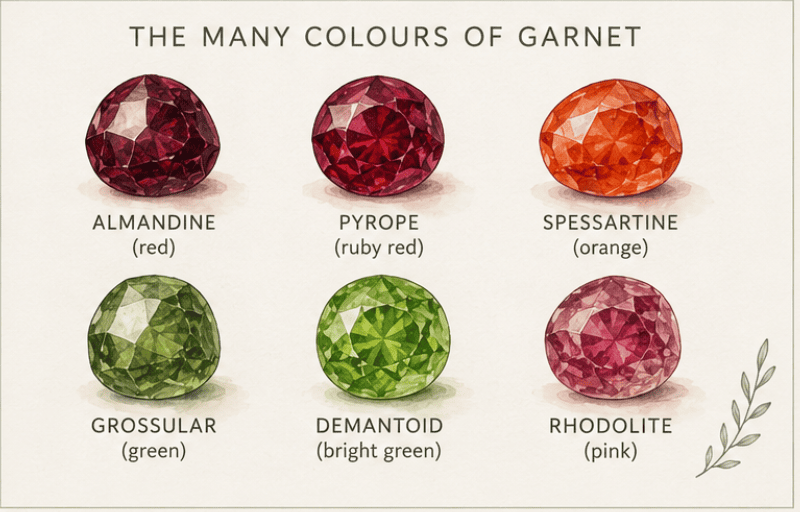
As garnets grow deep within the Earth, different chemical elements can take the place of one another within the crystal structure. Iron, magnesium, manganese, calcium and chromium all influence the colour and characteristics of the finished crystal.
Mineralogists divide garnets into two main chemical groups:
- Pyralspite Garnets – including Pyrope, Almandine and Spessartine. These are rich in aluminium and commonly contain magnesium, iron or manganese.
- Ugrandite Garnets – including Uvarovite, Grossular and Andradite. These are calcium-rich garnets, with chromium, aluminium or iron helping to create their distinctive colours.
Nature doesn’t always follow neat categories. Many garnets are natural blends of these species, producing an almost endless variety of colours and subtle differences. That’s why no two garnets are ever quite the same.
The next time you see a garnet, it’s worth remembering that its colour isn’t simply a surface feature—it’s a clue to the chemical ingredients and geological conditions present when that crystal formed millions of years ago.
How Do Garnets Form?
Every garnet begins its journey deep beneath the Earth’s surface.
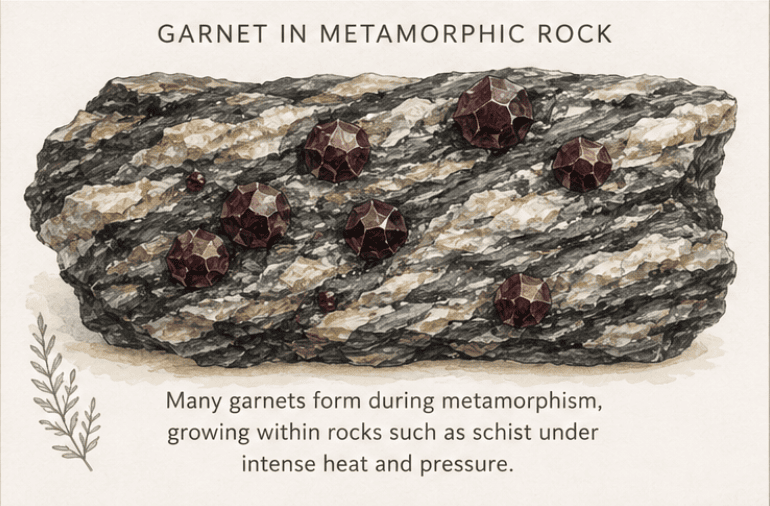
Most garnets form during metamorphism – a geological process in which existing rocks are transformed by intense heat and pressure over millions of years. Rather than melting, the minerals within the rock gradually recrystallise, allowing garnet crystals to grow.
Many garnets are found in metamorphic rocks such as schist and gneiss, where they often appear as beautifully formed crystals embedded within the surrounding rock. Other varieties can form in certain igneous rocks, where molten rock cools and crystallises beneath the Earth’s surface.
Because garnets are both hard and resistant to weathering, they often survive long after the rocks that contained them have broken down. Rivers can carry the crystals away from their original source, depositing them in sands and gravels where they may eventually be discovered.
Each garnet is therefore a small piece of Earth’s geological history, shaped by immense forces operating far below our feet over millions of years.
Garnet Through History
Long before modern geology explained how garnets formed, people were captivated by their rich colours and remarkable durability. Garnet jewellery has been discovered in archaeological sites dating back thousands of years, showing that these beautiful minerals have been treasured across many different cultures.
The Ancient Egyptians used garnets in jewellery and decorative objects, while the Ancient Romans carved them into signet rings used to stamp wax seals on important documents. Centuries later, garnets became especially popular in Victorian jewellery, where their deep red colour made them a favourite gemstone for brooches, necklaces and rings.
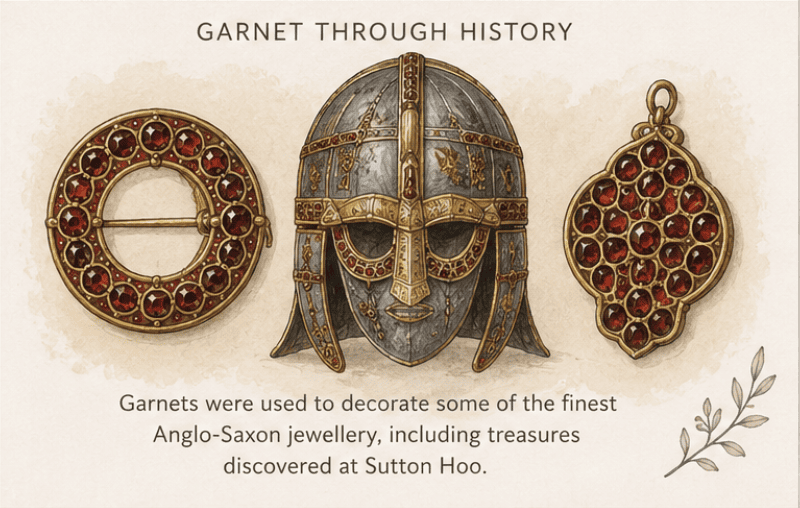
Here in Britain, garnets have also played a small part in our history. They appear in the magnificent Anglo-Saxon treasures discovered at Sutton Hoo in Suffolk, where finely cut garnets were set into intricate gold jewellery over 1,300 years ago. These remarkable artefacts demonstrate the exceptional craftsmanship of the time and show just how highly prized garnets were.
Today, garnets continue to be admired around the world. While they remain the traditional birthstone for January, their greatest appeal lies in the extraordinary variety found within the garnet family. From deep crimson reds to vibrant greens and glowing oranges, each garnet tells a story that began millions of years before it was ever discovered.
Where Can Garnets Be Found?
Although garnets are found on every continent, different varieties form in different geological environments around the world. Today, important sources include India, Madagascar, Sri Lanka, Tanzania, Namibia, Brazil, Pakistan and the United States, each producing garnets with their own distinctive colours and characteristics.
Some parts of the world have become famous for producing particular garnet varieties. For example, the vivid green Tsavorite is found in East Africa, while the highly prized Demantoid garnet was first discovered in Russia’s Ural Mountains. Deep red almandine garnets are among the most widespread and are commonly found in metamorphic rocks across many parts of the world.
Garnet at The Crystal Tree
At The Crystal Tree, garnet is one of those minerals that continually surprises us. While many people picture a deep red gemstone, the garnet family is far more diverse, with colours ranging from rich reds and glowing oranges to vibrant greens and delicate pinks.
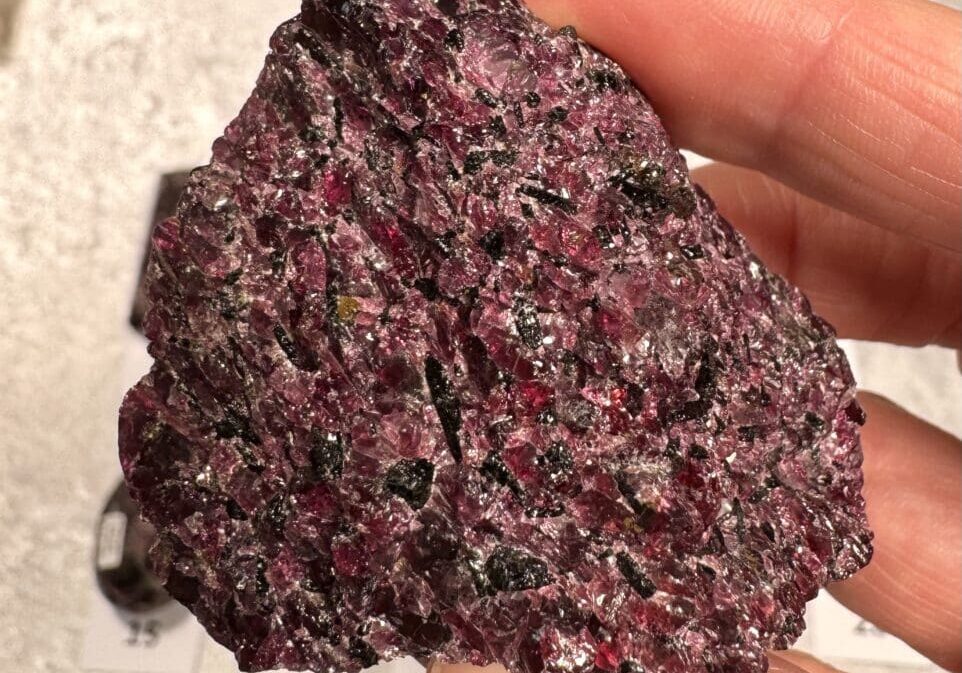
Over the years we’ve enjoyed finding garnets in a variety of natural forms. Some specimens reveal beautifully formed crystals within their host rock, while others have grown alongside minerals such as tourmaline or occur naturally within limestone, each offering another glimpse into the remarkable conditions in which these minerals formed.
Whether you’re drawn to garnet because it’s your birthstone, its incredible range of colours, or simply its geological story, we hope it inspires the same sense of curiosity that continues to inspire us every time we discover a new specimen.
Quick Facts
Mineral Group: Garnet
Chemical Group: Silicate
Crystal System: Cubic (Isometric)
Hardness: 6.5–7.5 on the Mohs scale
Typical Colours: Red, orange, yellow, green, pink, brown and black
Common Geological Settings: Mainly metamorphic rocks, with some varieties also forming in igneous rocks.
Birthstone: January
Continue Exploring Earth’s Hidden Treasures
Every mineral has a story.
From gemstones formed deep within the Earth to remarkable discoveries from around the world, our Crystal Library explores the geology, history and natural beauty of Earth’s hidden treasures.
Here some others blog posts for you

Birthstones – Who Decided Which Stone Belongs to Each Month?
Celebrating International Rock Day: The Stories Hidden in Stone
