
Celebrating International Rock Day: The Stories Hidden in Stone

Happy International Rock Day – Celebrating Earth’s Hidden Treasures
International Rock Day, celebrated on 13 July, may not be an officially recognised global observance like Earth Day or World Oceans Day, but it has become a popular annual celebration among geologists, museums, educators, rock collectors and nature enthusiasts around the world.
The day is all about appreciating the incredible geological treasures that shape our planet – from everyday pebbles and dramatic cliffs to fossils, minerals, gemstones and crystals. It’s a chance to look beneath our feet and discover the remarkable stories written in stone over billions of years. It encourages people of all ages to explore, learn about and appreciate the rocks, minerals, fossils and crystals that reveal our planet’s fascinating history.
For crystal lovers, it’s also a reminder that every crystal is part of a much bigger geological story. Before becoming a beautiful specimen for a collection or a meaningful piece of jewellery, each one formed deep within the Earth through extraordinary natural processes.
Why Are Crystals So Beautiful? We believe the greatest stories are written by nature herself…
Long before the first forests covered the land, before dinosaurs walked the Earth, and millions of years before humans ever paused to admire them, crystals were already beginning their extraordinary journey.
Far beneath our feet, hidden in darkness, the Earth was quietly at work.
Deep underground, molten rock cooled so slowly that atoms had time to arrange themselves with astonishing precision. Elsewhere, mineral-rich water crept through tiny cracks in ancient rock, leaving behind microscopic layers that, grain by grain, grew into glittering crystals. In places of immense heat and crushing pressure, new minerals emerged as the Earth constantly reshaped itself.
It wasn’t a process measured in days or years. It unfolded over thousands, sometimes millions, of years.
Nature doesn’t rush.
Each atom settles into place like a perfectly choreographed dance, repeating the same pattern over and over again until a crystal begins to take shape. This remarkable order is what gives crystals their beautiful geometric forms. Cubes, points, prisms and hexagons aren’t designed by human hands—they’re written into the mineral itself. 
Then comes colour.
Pure quartz is almost invisible, but the Earth is rarely perfect. Tiny traces of iron, manganese or other elements become trapped as the crystal grows. Over vast stretches of time, heat, pressure and even natural radiation can transform these minute impurities into the rich purples of amethyst, the smoky greys of smoky quartz, or the delicate pinks found in rose quartz.
Light completes the masterpiece.
As sunlight strikes a crystal, it may pass straight through, bounce from polished faces or scatter from tiny imperfections hidden within. Some minerals shimmer like silk, others flash brilliant blues and greens, while some reveal rainbows that seem to appear from nowhere. These aren’t tricks or illusions – they’re simply light interacting with structures that nature has spent millions of years creating.
Perhaps that’s what makes crystals so captivating!
When you pick one up, you’re not simply holding a beautiful object. You’re holding a fragment of Earth’s story – a piece of a planet that has been endlessly creating, changing and recycling itself for over four billion years.
Every crystal has survived an unimaginable journey. It may have formed in the heart of an ancient volcano, deep within a mountain range that has long since eroded away, or inside rocks that lay hidden beneath the surface until they were finally uncovered.
And after all that time, against all the odds, it has found its way into your hands.
It’s a humbling thought. The beauty of a crystal isn’t just in its colour or its sparkle. It’s in the incredible journey it has taken to get here.
In a world that often demands instant results, a crystal is a gentle reminder that some of nature’s greatest masterpieces can only be created by patience, pressure and time.
Every Crystal Has a Beginning
Nature doesn’t create every crystal in the same way.
Some begin their journey in rivers of molten rock. Others are transformed beneath mountain ranges by immense heat and pressure. Some slowly grow from mineral-rich waters deep within the Earth’s crust, while others form as ancient seas evaporate.
Although their beginnings are very different, they all share one remarkable thing in common – they are the product of an ever-changing planet that has been shaping itself for billions of years.
The illustration below introduces the four main ways crystals are formed. It isn’t just geology; it’s the opening chapter in the story of every crystal you see today.

The Four Birth Stories of Crystals
At first glance, the infographic might seem to divide crystals into neat categories, but nature is rarely that simple. Many minerals can form in more than one environment, and some experience several stages of Earth’s incredible rock cycle before reaching the form we eventually discover.
The important thing isn’t memorising the categories. It’s recognising that every crystal has travelled a unique geological journey. Whether born in fire, transformed by immense pressure, created through water, or grown from hot underground fluids, each one is evidence of the remarkable forces that continue to shape our planet.
Earth’s Greatest Recycling Project
If crystals have different beginnings, what links them together?
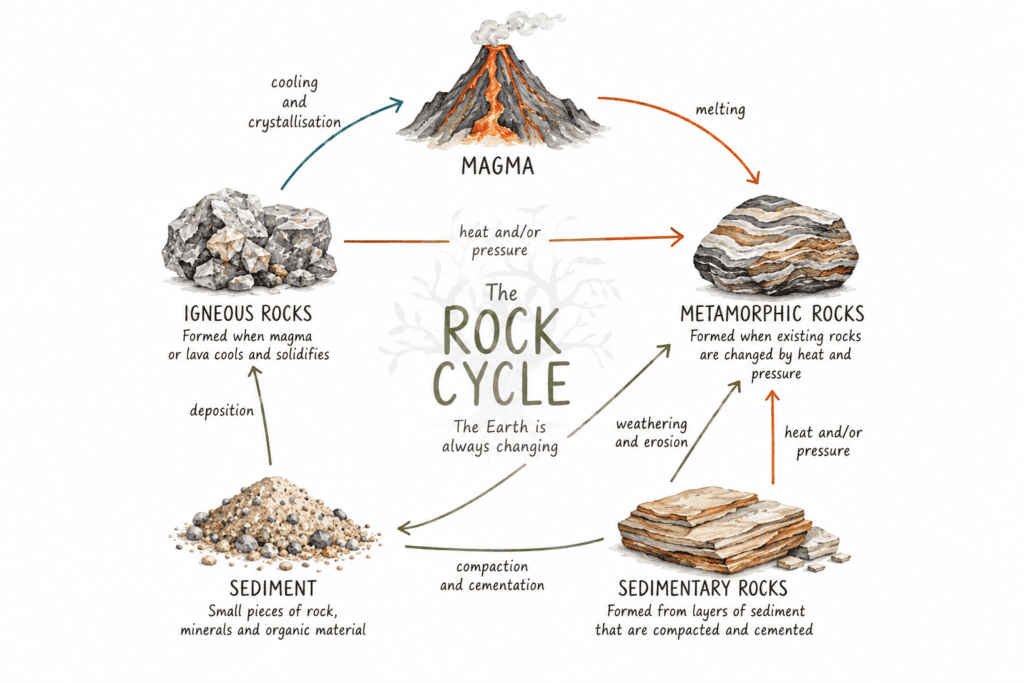
The answer lies in one of the most extraordinary processes on our planet—the rock cycle.
The Earth is never still. Mountains rise and erode. Volcanoes erupt. Oceans appear and disappear. Rocks are buried, melted, broken apart and rebuilt over millions of years. Geologists call this continuous process the rock cycle, and it is responsible for creating the conditions in which many of the world’s most beautiful crystals can form.
The next time you hold a crystal in your hand, pause for just a moment. Imagine the journey it has taken. Picture continents colliding, volcanoes erupting, oceans advancing and retreating. While countless species appeared and disappeared, while mountains rose and slowly wore away, that crystal was quietly growing, atom by atom, in the darkness beneath the Earth’s surface.
The Earth has been telling its story for over four billion years. We simply have the privilege of listening.
Every crystal has a story.
Not a story we’ve invented…
A story written by volcanoes, oceans, mountains, pressure and time.
The natural world is full of remarkable stories. If you’d like to explore further, these short videos beautifully illustrate some of the geological processes mentioned in this article.
Here some others blog posts for you

Birthstones – Who Decided Which Stone Belongs to Each Month?

Stilbite & Scolecite Polished Stones
