
Beryl: One Mineral, Many Gemstones
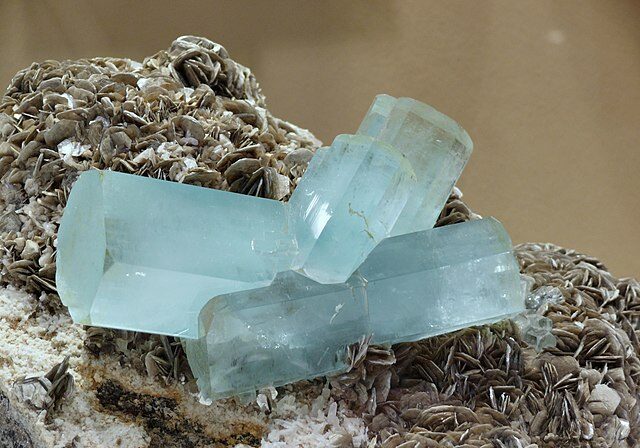
Beryl
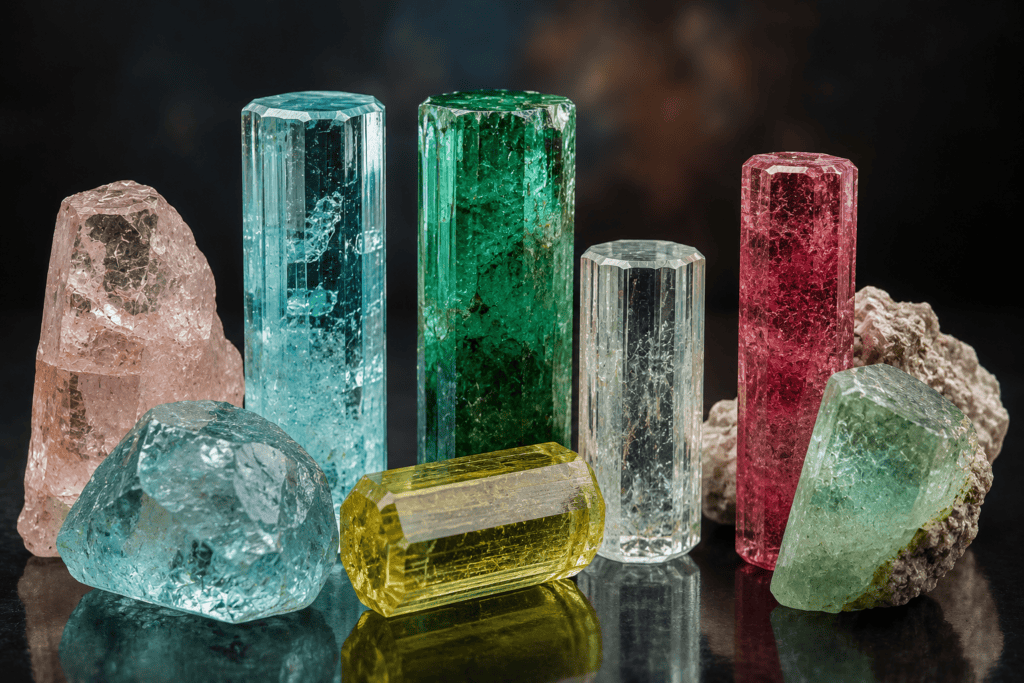
At first glance, an Emerald, an Aquamarine and a Morganite might appear to have very little in common.
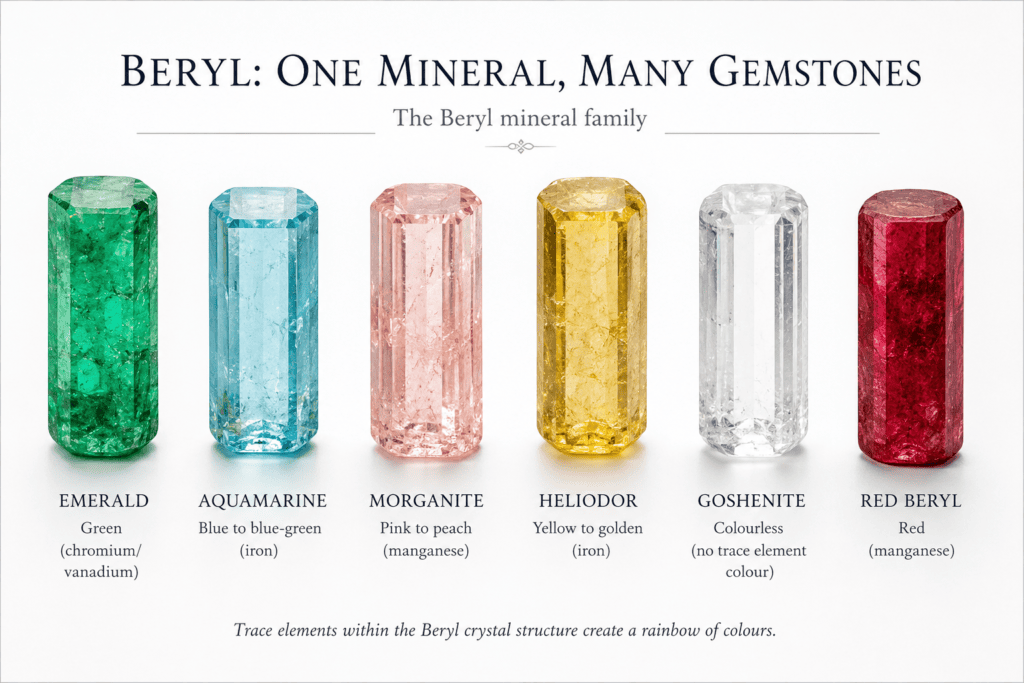
One can be an intense green, another the soft blue of clear water, while another may be delicate pink or peach. Add golden Heliodor, colourless Goshenite and the extraordinarily rare Red Beryl, and they look like an entire collection of different gemstones.
Yet they are all varieties of the same mineral: Beryl.
What separates them is often just a tiny change in chemistry. Trace amounts of elements such as iron, chromium, vanadium and manganese can transform otherwise colourless Beryl into some of the world’s most recognisable gemstones.
Beryl has another trick up its sleeve too. It forms beautiful hexagonal crystals, can grow to remarkable sizes, and occurs in geological environments ranging from granite pegmatites to hydrothermal and metamorphic settings.
So how can one mineral produce an Emerald, an Aquamarine, a Morganite — and even one of the rarest gemstones on Earth?
It all begins with the structure of Beryl itself.
What Is Beryl?
Beryl is a beryllium aluminium silicate mineral with the chemical formula Be₃Al₂Si₆O₁₈. It belongs to the silicate family and crystallises in the hexagonal crystal system, which is why natural Beryl crystals so often grow as distinctive six-sided prisms. It is also a relatively hard mineral, measuring around 7.5–8 on the Mohs scale.
In its chemically pure form, Beryl is actually colourless. The wonderful greens, blues, pinks, yellows and reds we associate with the Beryl family appear when small amounts of other elements become incorporated into the crystal as it grows.
This is where Beryl becomes particularly interesting.
Chromium and vanadium can create the rich green of Emerald. Iron is responsible for the blue tones of Aquamarine and plays an important role in yellow Heliodor, while manganese is associated with the pink of Morganite and the remarkable colour of Red Beryl. Remove those colour-causing trace elements and we arrive at colourless Goshenite.
So although these gemstones have been given different names — and can look dramatically different from one another — underneath the colour they share the same basic Beryl structure.
One mineral, with just a few tiny chemical changes, can create an extraordinary family of gemstones.
How Does Beryl Form?
To make Beryl, the right ingredients have to come together — and one of the most important is beryllium, an element that is relatively scarce in the Earth’s crust.
Many Beryl crystals form in granitic pegmatites. These are exceptionally coarse-grained igneous rocks that develop during the final stages of crystallisation of certain magmas. As the magma cools, remaining melts and fluids can become enriched in elements that did not easily fit into the minerals that formed earlier — including beryllium. Under the right conditions, Beryl can begin to crystallise.
Pegmatites can provide plenty of space and the right chemical environment for crystals to grow, which helps explain why Beryl can sometimes form those wonderful long, well-developed hexagonal prisms. Aquamarine, Morganite, Heliodor and colourless Beryl are particularly associated with pegmatite environments.
But not every member of the Beryl family forms in exactly the same way.
Emerald is a particularly interesting exception. To create its characteristic green colour, Beryl needs access to chromium and/or vanadium, and bringing those colour-causing elements together with beryllium requires an unusual combination of geological circumstances. Emerald deposits can therefore occur where different rocks and mineral-rich fluids have interacted through metamorphic and hydrothermal processes.
Even Red Beryl has its own unusual geological story, occurring in volcanic rocks in Utah rather than the classic gemstone-bearing pegmatites associated with many of its Beryl relatives.
So although all these gemstones share the same basic mineral structure, where and how that Beryl grows can be remarkably different.
Meet the Beryl Family
Few mineral families can rival Beryl for sheer variety. Change just a tiny part of its chemistry and the result can look so different that you would never guess the crystals were closely related.
Emerald is perhaps the most famous member of the family. Its green colour comes principally from traces of chromium and/or vanadium. Interestingly, not every green Beryl is automatically considered Emerald — lighter or less saturated material may simply be described as Green Beryl, and even gemmologists don’t entirely agree on exactly where Green Beryl ends and Emerald begins.
Aquamarine ranges from pale blue and greenish-blue to stronger blue. Its colour is produced by iron, and its name comes from the Latin for seawater — a wonderfully appropriate name for a gemstone whose colours can resemble everything from shallow tropical water to a deeper blue sea.
Morganite brings an entirely different palette to the family, ranging through delicate pink, peach and salmon tones. Its colour is associated with manganese, and although the mineral itself has existed for millions of years, the name Morganite is surprisingly modern. We’ll come back to that story later.
Heliodor, or Golden Beryl, ranges from yellow to golden and sometimes slightly greenish-yellow. Iron is again involved in producing the colour — a lovely example of how the same element can contribute to both the blues of Aquamarine and the yellows of Heliodor depending upon how it occurs within the crystal structure.
Goshenite is colourless Beryl. Without the trace elements responsible for its more colourful relatives, we get a glimpse of what pure Beryl itself looks like.
And then there is Red Beryl.
Coloured by manganese, Red Beryl is an exceptionally rare member of the family. Gem-quality material is famously associated with Utah in the United States, where it formed under very different geological conditions from many of its Beryl relatives.
Put them alongside one another and it seems remarkable that Emerald, Aquamarine, Morganite, Heliodor, Goshenite and Red Beryl all begin with essentially the same mineral.
The difference is in the details — and sometimes the tiniest detail can completely change what we see.
From Sea Water to Emerald Green – The Names Behind Beryl
The Beryl family may share the same mineral structure, but its gemstones acquired their names at very different points in history.
The word Beryl itself is ancient. It came into English through Latin beryllus and Greek beryllos, words used historically for precious blue-green stones. Its linguistic roots appear to stretch even further back towards ancient South Asian languages and the long-distance gemstone trade.
Aquamarine has perhaps the most wonderfully descriptive name of the family. It comes from the Latin aqua, meaning water, and marina, meaning “of the sea” — quite literally, water of the sea.
Its watery colour also inspired centuries of folklore. Aquamarine became particularly associated with sailors and the sea, with traditions claiming that it could calm waves and protect those travelling across the water.
Emerald has an even longer story. Its name travelled through several ancient languages before eventually reaching English, while beautiful green Beryl had been mined and treasured long before anyone understood that Emerald and Aquamarine were varieties of the same mineral.
Morganite wasn’t given its familiar name until the early 20th century. Pink Beryl was already known, but in 1911, gemmologist George Frederick Kunz proposed the name Morganite in honour of the American financier and enthusiastic gem collector J. P. Morgan. Morgan was also an important patron of the arts and sciences, and Kunz had helped build and catalogue his remarkable gemstone collection.
Heliodor, meanwhile, has a name inspired by its colour rather than a person. Its name comes from Greek words meaning “gift of the sun” — a wonderfully appropriate description for golden-yellow Beryl.
And Goshenite takes its name not from its colour at all, but from Goshen, Massachusetts, where colourless Beryl was found.
Even the names of the Beryl family therefore tell us something interesting: humans were collecting, trading and naming these beautiful stones long before mineralogy revealed that beneath their dramatically different colours, they were members of the same family all along.
Aquamarine
Of all the Beryl varieties, Aquamarine perhaps displays the mineral’s crystal form most beautifully. It can grow as remarkably clear, well-formed hexagonal prisms, sometimes reaching extraordinary sizes. GIA notes that Aquamarine crystals are particularly prized by mineral collectors because they can be both large and exceptionally clean.
Its colour ranges from greenish blue through to blue, created by traces of iron within the Beryl crystal structure. Natural Aquamarine often contains more green than the bright blue stones we see in jewellery, and much of the material on the gemstone market is gently heated to reduce that greenish component and produce a purer blue. The treatment is widely accepted within the gem trade and is considered stable.
But perhaps the best way to appreciate what Beryl is capable of is to look at some of the extraordinary Aquamarine crystals the Earth has produced.
In 1910, a crystal weighing an astonishing 110.5 kg (244 lb) was discovered at Marambaia in Minas Gerais, Brazil. Known as the Papamel, it is recorded by GIA as the largest known gem-quality Aquamarine crystal.
And Brazil produced another remarkable Aquamarine decades later.
A huge crystal discovered in Minas Gerais in the late 1980s broke into three pieces during its excavation. The largest surviving piece eventually reached German gem artist Bernd Munsteiner, who transformed it into something quite unlike a conventional faceted gemstone.
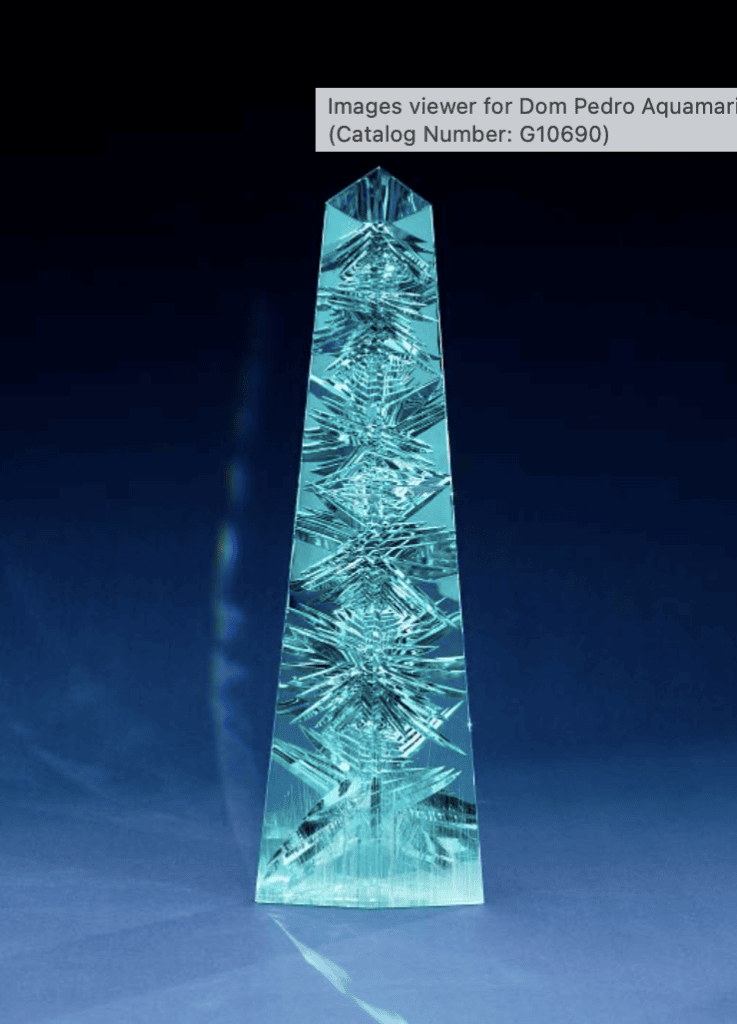 The result was the Dom Pedro Aquamarine — a slender, obelisk-shaped sculpture standing around 35 cm tall and weighing 10,363 carats. Rather than simply cutting facets around its surface, Munsteiner carved patterns into the back of the crystal so that light reflects through its interior, making the blue Beryl appear almost illuminated from within. Today it belongs to the Smithsonian’s National Gem and Mineral Collection.
There’s something rather wonderful about the Dom Pedro. It isn’t simply a huge gemstone. You can still see some of the natural growth features within it, deliberately retained by Munsteiner as part of the finished sculpture.
A crystal that began growing deep within the Earth became both a gemstone and a work of art — without completely losing the story of how it formed.
Emerald – The Difficult Member of the Family
Aquamarine can form as wonderfully clear crystals, but its green relative Emerald has a reputation for being rather less cooperative.
Both are Beryl. Both have the same basic crystal structure. Yet Emerald commonly contains fractures, inclusions and other evidence of the complicated geological environment in which it formed.
Part of the reason lies in the ingredients needed to make an Emerald.
Beryllium, which is essential for Beryl, is typically associated with silica-rich geological environments. Chromium and vanadium — the elements responsible for Emerald’s green colour — are more commonly associated with very different types of rocks. Bringing them together in sufficient quantities requires an unusual geological coincidence.
When those ingredients finally meet through processes involving hot fluids, changing rocks and geological movement, the resulting Emerald crystals often record that turbulent history within them. Tiny mineral crystals, fluid-filled cavities and healed fractures can all become trapped as the Emerald grows.
Gemologists even have a rather lovely name for the complex network of inclusions sometimes seen inside Emerald: jardin, the French word for garden, because under magnification the inclusions can resemble tangled leaves and branches.
These inclusions don’t automatically make an Emerald undesirable. In fact, they can provide gemologists with valuable clues about whether a stone is natural and sometimes even about the geological environment in which it formed.
This also helps explain another striking difference within the Beryl family. Fine Aquamarine is often prized for being beautifully transparent and clean, while finding a natural Emerald with that same degree of clarity is much more unusual.
Same mineral. Different trace elements. Different geological journey. And an entirely different-looking gemstone.
Red Beryl – The Rarest of the Family
At the opposite end of the Beryl colour spectrum from Aquamarine sits one of its most unusual relatives: Red Beryl.
Its vivid red to pinkish-red colour is associated with manganese, but colour isn’t the only thing that makes Red Beryl exceptional. Unlike many gem-quality Beryls, which are strongly associated with granitic pegmatites, the best-known Red Beryl formed in volcanic rhyolite in Utah in the United States.
Red Beryl was first discovered in Utah in 1904 by mineral prospector Maynard Bixby. It was initially called bixbite in his honour, but that name has largely fallen out of favour — partly because it could so easily be confused with bixbyite, an entirely different mineral also named after him.
The most important gem-quality source was later discovered in the Wah Wah Mountains of Utah, at what became known as the Ruby-Violet or Red Beryl Mine. Here, hot mineral-rich fluids and gases moved through fractures in cooling volcanic rock, creating the unusual conditions in which tiny Red Beryl crystals could grow.
And tiny is an important word.
Unlike the enormous Aquamarine crystals Beryl is capable of producing, Red Beryl crystals are generally very small. Transparent material suitable for cutting into gemstones is rarer still, and cut stones weighing more than a carat are exceptional.
That makes Red Beryl a wonderful demonstration of just how much the geological environment matters.
The same mineral structure that can produce an Aquamarine crystal weighing more than 100 kilograms can, under completely different conditions, produce tiny red crystals where a single gem-quality carat is something remarkable.
Beryl may be one mineral — but the Earth certainly doesn’t make every member of the family in the same way.
Myths, Legends and the Beryl Family
Long before anyone knew that Emerald and Aquamarine were varieties of the same mineral, people were already surrounding these gemstones with stories.
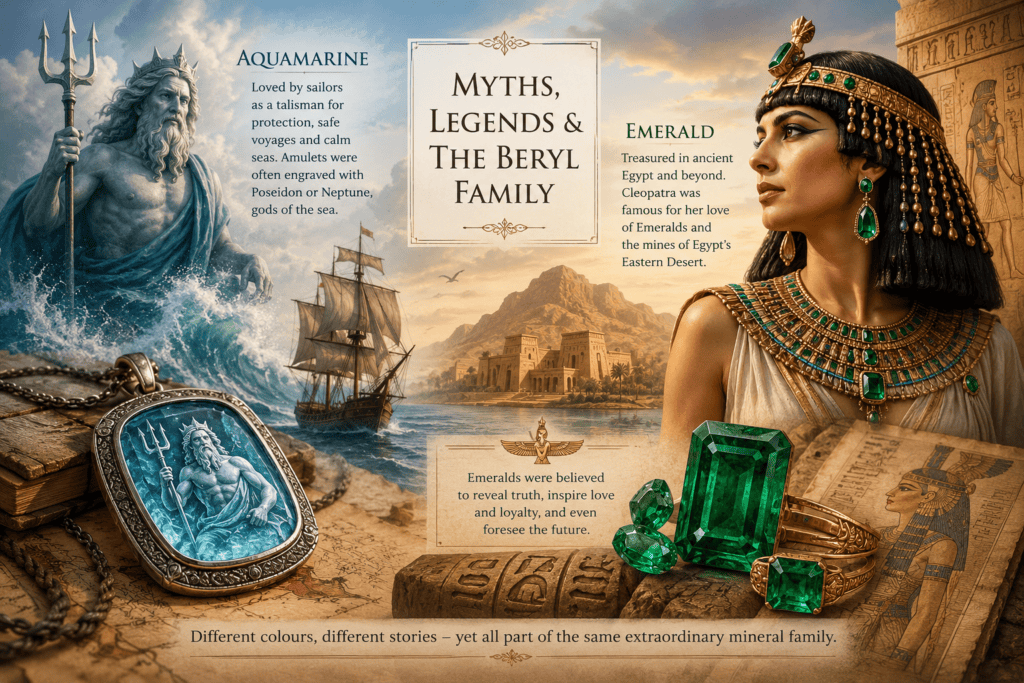
Perhaps unsurprisingly, Aquamarine became closely associated with the sea. Its blue-green colour inspired the belief that it could calm waves and protect sailors during their voyages. Some sailors even carried Aquamarine amulets engraved with images of Poseidon or Neptune, the Greek and Roman gods of the sea.
That makes the old association rather more interesting than simply saying Aquamarine was the “treasure of mermaids”. The mermaid story is repeated everywhere today, but I’ve found much better support for the tradition of sailors, sea gods and protective amulets than for the romantic tale of Aquamarine being lost mermaid treasure.
Emerald, meanwhile, has an extraordinary history of its own.
Emeralds were being mined in Egypt more than two thousand years ago, and Cleopatra VII became famously associated with the gemstone. The Ptolemaic rulers exploited Emerald mines in Egypt’s Eastern Desert, and Cleopatra is recorded as having a particular passion for Emerald and using it in her royal adornments.
Over the centuries, Emerald accumulated an impressive collection of beliefs. It was said to reveal truth, allow its wearer to foresee the future and even expose whether a lover’s promises were genuine. None of these are properties modern mineralogy can demonstrate, of course, but they tell us something fascinating about the importance people once placed upon these intensely green stones.
And perhaps that is one of the most interesting things about the Beryl family.
The people who carried blue Aquamarine for protection at sea and treasured green Emerald as a symbol of truth had no idea that beneath their dramatically different colours, they were admiring varieties of the same mineral.
The stories came first.
The geology that connected them came much later.
Where Is Beryl Found?
Beryl occurs across the world — Mindat records more than 7,000 localities — but particular regions have become famous for very different members of the family.
Brazil is one of the great Beryl-producing countries. The pegmatites of Minas Gerais are particularly famous for Aquamarine, Morganite and other varieties of Beryl. We’ve already met one extraordinary Brazilian Aquamarine in the Dom Pedro, but the region has produced countless beautiful crystals and gemstones. Most Morganite on today’s market also comes from the pegmatite mines of Minas Gerais.
High in the mountains of Pakistan, particularly around the Shigar and Skardu regions, pegmatites produce spectacular Aquamarine crystals. Some deposits lie thousands of metres above sea level, where miners work on steep mountain faces to reach crystal-bearing pockets in the rock. Afghanistan also produces beautiful Beryl from its mountainous pegmatite regions.
Colombia is world-famous for Emerald, particularly the historic districts of Muzo and Chivor. Zambia is another major Emerald-producing country, while important deposits are also found in Brazil, Zimbabwe, Afghanistan and Pakistan.
Madagascar deserves a special mention because it produces several members of the family, including Aquamarine and Morganite. The original Madagascan Morganite deposits became particularly renowned for their beautiful colour, and GIA still describes this material as a benchmark for quality.
Aquamarine is also found in Mozambique, Nigeria, Zambia, Madagascar and numerous other countries, while Heliodor and colourless Beryl occur in localities scattered around the world. GIA’s own reference collection contains Beryls from countries as diverse as Brazil, Kenya, Madagascar, Sri Lanka, Zimbabwe, Mozambique, Myanmar and Ukraine.
And then, once again, there is the odd one out.
Gem-quality Red Beryl is famously associated with Utah in the United States, its unusual volcanic origin setting it apart from the pegmatite-hosted Beryls found in many other parts of the world.
So there isn’t really one place we can point to as the home of Beryl.
Its family is scattered across the planet — blue crystals high in mountain pegmatites, Emeralds hidden within ancient rocks, pink Morganite in Brazil and Madagascar, and tiny red crystals tucked inside the volcanic rocks of Utah.
Same mineral family. Completely different journeys through the Earth.
One Mineral, An Extraordinary Family
It is difficult to look at a deep green Emerald, a sea-blue Aquamarine and a delicate pink Morganite and imagine that, beneath their colours, they are all varieties of the same mineral.
Yet that is what makes Beryl such a fascinating family.
The basic crystal structure remains the same, while tiny changes in chemistry and geological environment create gemstones that can look completely different from one another. Iron can help turn Beryl blue or yellow, chromium and vanadium can create the green of Emerald, and manganese can produce everything from gentle pink Morganite to extraordinarily rare Red Beryl.
Their journeys through the Earth can be just as different. Some grow into beautiful hexagonal crystals within pegmatites, others form where unusual combinations of rocks and mineral-rich fluids meet, while Red Beryl found its home in the volcanic rocks of Utah.
Then humans added another layer to their story — giving them different names, carrying Aquamarine across the seas, treasuring Emerald for thousands of years and eventually discovering that these apparently unrelated gemstones belonged together all along.
Perhaps that is the real wonder of Beryl.
One mineral. A handful of trace elements. And an extraordinary collection of gemstones created by the Earth.
Here some others blog posts for you

Birthstones – Who Decided Which Stone Belongs to Each Month?
Celebrating International Rock Day: The Stories Hidden in Stone
