
Quartz – One of Earth’s Most Remarkable Minerals
Earth’s Hidden Treasures Journal
Approx. reading time: 13 minutes
In This Article
- What Is Quartz?
- Why Does Quartz Come in So Many Colours?
- Quartz Isn’t Always a Crystal Point
- How Does Quartz Form?
- The Quartz Crystal Hiding in Your Watch
- Quartz Through History
- Where Is Quartz Found?
- When Quartz Isn’t Quite What It Seems?
- One of Earth’s Most Remarkable Minerals
Topics Covered
Mineralogy • Geology • Quartz Varieties • History • Technology
Quick Facts
Mineral: Quartz
Chemical Formula: SiO₂ – silicon dioxide
Mineral Group: Silicates
Crystal System: Trigonal
Hardness: 7 on the Mohs scale
Typical Colours: Colourless, white, purple, yellow, brown, pink, green and many others
Common Varieties: Rock Crystal, Amethyst, Citrine, Smoky Quartz, Rose Quartz and Prasiolite
Where It Forms: Igneous, metamorphic and sedimentary environments
Special Property: Piezoelectric – Quartz can convert mechanical pressure into an electrical charge and vice versa
Did You Know? Quartz is one of the most abundant minerals in Earth’s continental crust.
Quartz is everywhere.
It grows as beautiful transparent crystals, fills veins running through ancient rocks, forms sparkling grains in granite and can survive weathering long enough to become part of the sand beneath our feet.
Yet Quartz is also capable of extraordinary variety.
It can be perfectly clear or almost black. It can become purple Amethyst, golden Citrine, smoky brown Quartz or delicate pink Rose Quartz. And when its crystals become so tiny that we can no longer distinguish them with the naked eye, we enter the fascinating world of Chalcedony — bringing Agate, Carnelian, Onyx, Bloodstone and many other familiar stones into the wider Quartz story.
But Quartz isn’t important simply because it is beautiful.
Its unusual physical properties have made it useful far beyond the world of gemstones and mineral collecting. Quartz has played a role in watches, radios, electronics and precision instruments, while geologists can use the chemistry locked inside individual crystals to uncover clues about the conditions in which they formed.
Few minerals connect so many different worlds — geology, gemstones, technology and even the landscape around us.
So perhaps the Quartz crystal sitting on a shelf isn’t quite as ordinary as its familiarity might suggest.
To understand why Quartz is so remarkable, we need to start with what it actually is.
What Is Quartz?
Quartz is a naturally occurring mineral made from just two elements: silicon and oxygen, giving it the chemical formula SiO₂.
It is one of the most common minerals in the Earth’s continental crust and is an important component of many igneous, metamorphic and sedimentary rocks. Granite commonly contains Quartz, sandstone may consist largely of Quartz grains, and Quartz can also form veins running through existing rock.
Quartz measures 7 on the Mohs hardness scale, making it relatively resistant to scratching and weathering. That durability is one reason Quartz can survive after many of the minerals surrounding it have broken down. Released from its original rock, those tough little grains can be carried by rivers, rolled along coastlines and eventually become part of beaches and sandstones.
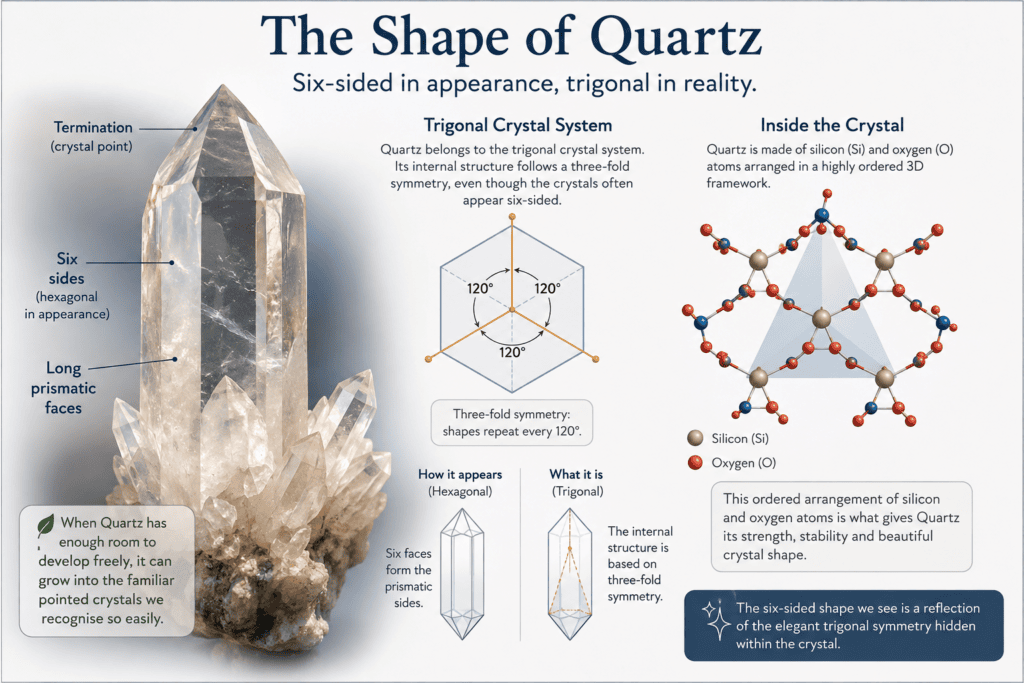
When Quartz has enough room to develop freely, it can grow into the familiar pointed crystals we recognise so easily. They often appear to be six-sided, although mineralogically Quartz actually belongs to the trigonal crystal system. Its characteristic shape reflects the remarkably ordered arrangement of silicon and oxygen atoms inside the crystal.
And Quartz can grow in an extraordinary range of environments. Crystals may develop from hot mineral-rich fluids flowing through fractures, from silica-rich fluids associated with pegmatites, inside cavities in volcanic rocks, and even under conditions much closer to the Earth’s surface.
Perhaps most surprisingly, chemically pure Quartz is colourless.
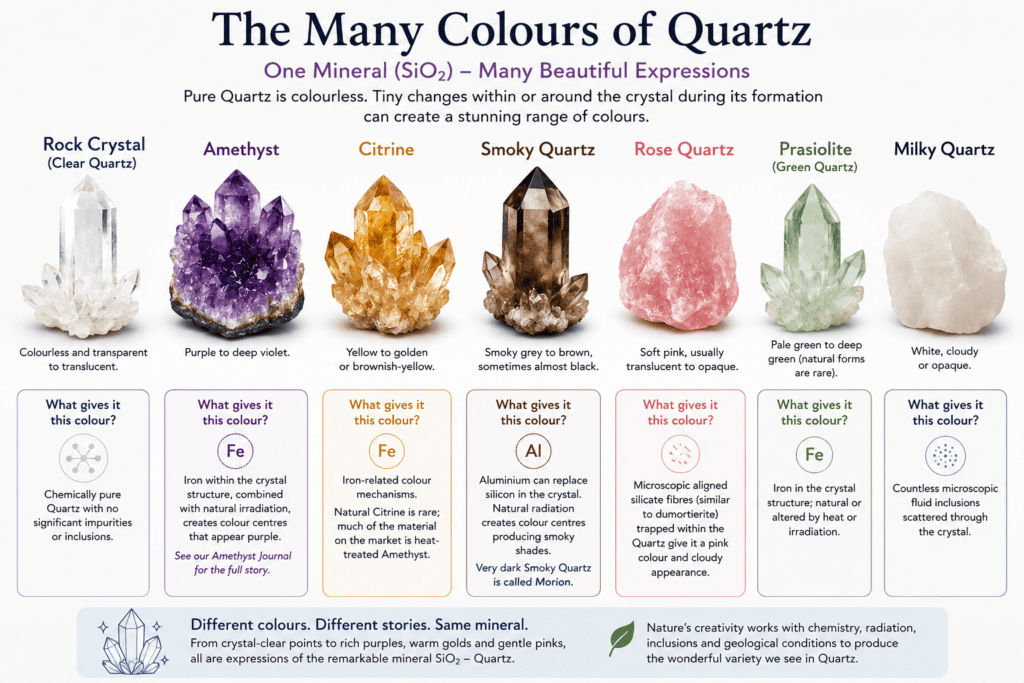
The purples, yellows, browns, pinks and other colours we associate with familiar Quartz varieties arise because something has changed — perhaps trace elements have entered the crystal, natural radiation has altered colour centres within it, or microscopic inclusions have become trapped during growth.
And that is where Quartz becomes much more colourful.
Why Does Quartz Come in So Many Colours?
Pure Quartz is colourless. But nature rarely works with perfectly pure ingredients, and tiny changes within or around a growing Quartz crystal can produce an extraordinary range of colours.
Sometimes trace elements replace atoms within the crystal structure. Sometimes natural radiation changes the way electrons behave around those impurities, creating what mineralogists call colour centres. And sometimes the colour doesn’t really belong to the Quartz at all — it comes from microscopic inclusions of another mineral trapped inside it.
That means the different colours of Quartz don’t all have the same explanation.
Amethyst owes its purple colour to iron-related defects within the Quartz structure combined with natural irradiation. We’ve explored that process — and the extraordinary geological story of Amethyst — in much more detail in our separate Amethyst Journal.
Smoky Quartz has a different recipe. Aluminium can substitute for silicon within the crystal, and exposure to natural radiation then creates colour centres responsible for shades ranging from smoky grey and brown to almost black. Very dark Smoky Quartz is sometimes known as Morion.
Citrine ranges through yellow, golden and brownish-yellow tones and involves iron-related colour mechanisms. Natural Citrine exists, but it is considerably less common than many people realise. Much of the orange-yellow material sold commercially as Citrine began life as Amethyst and acquired its colour through heat treatment.
Then there is Rose Quartz, whose soft pink colour has a particularly interesting explanation. Research has found microscopic aligned silicate fibres within Rose Quartz, similar to the mineral dumortierite, which are responsible for its characteristic pink appearance. Those tiny inclusions also help explain why Rose Quartz is generally cloudy or translucent and usually occurs as massive material rather than the familiar transparent pointed crystals associated with Rock Crystal.
Even white Milky Quartz has a story. Its cloudy appearance can result from enormous numbers of microscopic fluid inclusions trapped within the Quartz as it crystallised.
And Quartz still hasn’t finished with its colour palette. Natural green Prasiolite exists too, although it is rare, while heating or irradiation can also alter the colour of some Quartz.
So when we put purple Amethyst, golden Citrine, brown Smoky Quartz and pink Rose Quartz alongside clear Rock Crystal, we’re not looking at completely different minerals.
We’re seeing how chemistry, radiation, inclusions and geological conditions can all leave their signature on the same basic mineral: SiO₂.
Quartz Isn’t Always a Crystal Point
When we think of Quartz, most of us probably picture a clear crystal point. Amethyst, Citrine and Smoky Quartz can all grow as recognisable crystals too.
But Quartz has another side to its story.
Sometimes the crystals are far too small for us to see individually. Instead of producing obvious crystal points, they form solid-looking masses — and this is where we meet Chalcedony.
Chalcedony opens the door to some very familiar stones.
Agate is famous for its bands and patterns. Carnelian brings warm oranges and reds. Onyx traditionally has parallel bands, while Chrysoprase is known for its beautiful green colour.
And then we have Jasper and Bloodstone, which belong to this wider microscopic silica story too.
So a sparkling Amethyst cluster and a beautifully patterned piece of Agate may look as though they have very little in common.
Look closely enough, however, and they are both connected to the extraordinary world of silica and Quartz.
That’s one of the reasons Quartz is such a fascinating mineral — sometimes its crystals are spectacularly obvious, and sometimes they’re hiding in plain sight.
How Does Quartz Form?
There isn’t just one way to make Quartz. It can form in several different geological environments, from cooling magma deep underground to hot mineral-rich fluids moving through cracks in existing rock.
One of the easiest ways to picture it is to imagine hot water travelling through the Earth.
Deep underground, water can become heated and carry dissolved silica along with it. As those fluids move into cracks and begin to cool, the silica can no longer remain dissolved so easily. It starts to crystallise, gradually depositing Quartz onto the walls of the crack.
Over time, this can create a Quartz vein — sometimes just a thin white line through the rock, and sometimes an enormous vein extending for a considerable distance.
But there’s an important difference between simply forming Quartz and growing one of those beautiful pointed crystals we recognise in the shop.
Quartz Needs Room to Grow
If Quartz forms where there isn’t much space, the crystals grow into one another and we may end up with a solid mass of Quartz.
Give those crystals an open cavity, however, and something much more spectacular can happen.
With room to grow freely, Quartz can develop its characteristic crystal faces and pointed terminations. The larger the available space — and the longer the right conditions continue — the greater the opportunity for impressive crystals to develop.
This also helps explain the magic inside a geode.
Some geodes begin with an empty space inside volcanic rock, such as a cavity left by a gas bubble. Mineral-rich water later moves through the rock and deposits minerals around the inside of that cavity, layer after layer. Quartz is one of the most common minerals found lining geodes.
Instead of filling the entire space, crystallisation may stop while a hollow centre remains.
Break open the rather ordinary-looking rock and suddenly there is a miniature crystal cave inside.
And perhaps that’s one of the loveliest things about Quartz:
the spectacular crystal we eventually see is the result of chemistry, water, temperature, time — and sometimes simply having enough room to grow.

The Quartz Crystal Hiding in Your Watch
A piece of Quartz sitting in a mineral collection and the tiny Quartz crystal inside a watch might seem to have very little in common.
But one of Quartz’s most remarkable properties is the reason it became so important to modern technology.
Quartz is piezoelectric. Put simply, when pressure is applied to a Quartz crystal, it can produce a tiny electrical charge. The process also works in reverse: apply an electrical voltage and the crystal changes shape ever so slightly.
That might sound like an interesting scientific curiosity, but it turned Quartz into an incredibly useful natural timekeeper.
Inside a typical Quartz watch is a tiny piece of specially cut Quartz. Electricity from the battery makes it vibrate at a remarkably steady frequency — commonly 32,768 times every second. The watch’s electronics count those vibrations and turn them into the seconds ticking past on the display.
Quartz oscillators were developed in the early 20th century and became important for accurate clocks and radio frequency control. Today, Quartz timing technology can be found throughout modern electronics.
There is another surprise too.
The Quartz used in modern electronic components isn’t normally mined from the Earth. Synthetic Quartz is grown specifically for technological use, allowing manufacturers to produce crystals with the purity and consistency they need.
So Quartz has made quite a journey.
It can grow naturally inside a cavity in rock over geological time, become a beautiful crystal specimen on a shelf — or be grown in a laboratory, cut into a tiny component and quietly keep track of every second of our day.
Not bad for one of the most familiar minerals on Earth.
Quartz Through History
Long before anyone knew that Quartz was made from silicon and oxygen, people were already trying to explain one of its most striking varieties — perfectly clear Rock Crystal.
The ancient Greeks called it krystallos, a word associated with ice. Classical writers recorded the belief that Rock Crystal was water that had frozen so intensely that it could never melt again. The idea may sound wonderfully imaginative today, but without modern mineralogy, a completely transparent crystal emerging naturally from rock must have been a rather mysterious thing.
That ancient association with ice eventually gave us the word crystal itself.
And people did far more than simply admire Quartz.
For thousands of years, skilled craftspeople have carved Rock Crystal into beads, seals, vessels, jewellery and decorative objects. Because Quartz is hard — measuring 7 on the Mohs scale — shaping and polishing it required considerable skill, particularly long before modern cutting equipment existed.
Some surviving pieces are extraordinary.
The collections of the British Museum include Rock Crystal objects spanning different cultures and periods, while magnificent carved Rock Crystal vessels were particularly prized in medieval Europe. Many were mounted with precious metals and gemstones and became treasured objects in royal and religious collections.
Quartz also found its way into another fascinating part of our cultural history: crystal balls.
Perfectly clear spheres were difficult to produce, which made large Rock Crystal balls unusual and valuable objects. Over time they became associated with attempts to see visions or divine the future — a practice often called scrying.
One famous example belonged to the Elizabethan scholar John Dee, adviser to Queen Elizabeth I. Dee was fascinated by mathematics, astronomy, navigation and alchemy, but also attempted to communicate with the spiritual world. Objects associated with those experiments survive today in the British Museum — including a crystal sphere.
Whether viewed as a gemstone, a scientific curiosity, a beautifully carved object or something mysterious, Quartz has clearly captured human attention for a very long time.
Perhaps that’s not surprising.
Even knowing the geology today, there is still something rather extraordinary about holding a completely transparent crystal that grew naturally inside the Earth.
An Ancient Medical Use for Quartz
Rock Crystal wasn’t valued only for decoration.
The Roman writer Pliny the Elder recorded a rather surprising medical use for clear Quartz. He described doctors using crystal spheres to concentrate the rays of the Sun, producing enough heat to cauterise areas of the body.
In effect, the polished Quartz was being used rather like a magnifying lens — focusing sunlight into a much smaller, hotter area.
It sounds extraordinary today, but cauterisation itself was an established medical practice in the ancient world. What makes this account so fascinating is the ingenious use of Quartz and sunlight to produce the necessary heat.
Where Is Quartz Found?
Quartz is one of the most widespread minerals on Earth, so asking “Where is Quartz found?” has a rather simple answer:
Almost everywhere.
It occurs on every continent and forms in an enormous variety of geological environments. But some locations have become particularly famous for producing exceptional Quartz crystals — whether because of their size, clarity, colour or unusual formations.
Brazil is one of the world’s best-known sources. The country produces spectacular Rock Crystal as well as Amethyst, Smoky Quartz and other varieties, with the state of Minas Gerais particularly famous for its mineral treasures.
Across the border, Uruguay is renowned for the intensely coloured Amethyst found inside volcanic rocks. Some cavities are lined with extraordinarily deep purple crystals — including the beautiful Uruguayan Amethyst pieces that occasionally find their way into our shop.
Madagascar is another important source of Quartz in many forms, including Rock Crystal, Rose Quartz and Smoky Quartz. The island’s remarkable geology has made it one of the world’s great mineral-producing regions.
The Alpine regions of Europe have their own celebrated Quartz story. For centuries, crystal hunters have searched high mountain clefts in the Alps for beautifully formed Rock Crystal and Smoky Quartz. Some specimens grew in cavities hidden within the mountains for millions of years before eventually being discovered.
And Quartz certainly isn’t restricted to distant or exotic locations.
It is abundant here in the UK, occurring in rocks and mineral veins across the country. Scotland in particular has a long association with Quartz varieties, including Smoky Quartz — traditionally known there as Cairngorm when referring to the characteristic brown to smoky material associated with the Cairngorm Mountains.
That’s perhaps the wonderful thing about Quartz.
A flawless crystal specimen may come from a famous mineral locality thousands of miles away, while an ordinary-looking piece of rock on a walk much closer to home may contain exactly the same mineral.
Quartz can be spectacular — but it is also part of the everyday geology beneath our feet.
When Quartz Isn’t Quite What It Seems
One of the fascinating things about Quartz is just how many different appearances it can take. But sometimes nature has had a little help — and sometimes the name on the label tells only part of the story.
That doesn’t necessarily make a crystal fake. It simply makes its story a little more interesting.
Take Citrine. Natural Citrine certainly exists, but much of the bright golden-orange Citrine available commercially actually began life as Amethyst. Heating changes the iron-related colour centres within the crystal, transforming purple into shades of yellow, orange or brown. Heat treatment of Quartz has a long history in the gem trade and should simply be disclosed for what it is.
Prasiolite, the green variety of Quartz, provides another example. Naturally occurring green Quartz is rare. Much of the Prasiolite seen commercially is produced by carefully heating certain Amethyst or by irradiation followed by heating. Only material with the right chemistry will make the transformation successfully.
Then there is the unmistakable shimmer of Aura Quartz.
Underneath those brilliant rainbow, blue or metallic colours is genuine Quartz. The effect, however, isn’t natural. A very thin layer of metal is bonded to the surface of the crystal, creating the colourful iridescent finish. The Quartz is real — the rainbow coating is human-made.
And What About All Those Quartz Names?
Quartz has also gathered an extraordinary collection of names over the years.
Some describe genuine mineral varieties. Others describe a particular appearance, locality or formation, while still others are trade names created within the crystal market.
Herkimer Diamond, for example, isn’t Diamond at all. It is the name given to particularly clear, commonly double-terminated Quartz crystals associated with Herkimer County and surrounding areas of New York State. Their natural brilliance and diamond-like appearance explain the name.
Names such as Lemurian Quartz, meanwhile, don’t describe separate mineral species. Geologically, the specimen is still Quartz. The additional name comes from the crystal trade and the stories or characteristics associated with particular specimens.
And that distinction is worth understanding.
A treated crystal can still be beautiful. A trade name can still be useful. And a human-altered specimen can still begin with a completely natural mineral.
The important thing is simply knowing what you’re looking at — and allowing the real story of the mineral to be part of its appeal.
One of Earth’s Most Remarkable Minerals
Quartz is so familiar that it can be easy to overlook just how extraordinary it really is.
It can grow as a perfectly clear crystal or become purple Amethyst, golden Citrine, smoky brown Quartz or soft pink Rose Quartz. Its crystals can be large enough to hold in your hand — or so tiny that they disappear into the colourful patterns of Chalcedony and Agate.
It grows in cracks, veins and hidden cavities deep within rock. It survives weathering to become part of the sand beneath our feet. Humans have carved it, collected it, puzzled over it and even used its unusual properties to keep incredibly accurate time.
And through all those different appearances and stories, the basic ingredients remain remarkably simple:
silicon and oxygen — SiO₂.
Perhaps that’s what makes Quartz so fascinating.
It isn’t one of Earth’s rarest minerals. Quite the opposite. Quartz is extraordinarily common.
But common doesn’t have to mean ordinary.
Sometimes the most remarkable treasures are the ones that have been around us all along.
Further Reading
Want to explore the mineralogy of Quartz in more detail?
Mindat – Quartz: A detailed mineralogical reference covering Quartz properties, varieties, crystal forms, localities and further scientific information.

Here some others blog posts for you

Birthstones – Who Decided Which Stone Belongs to Each Month?
Celebrating International Rock Day: The Stories Hidden in Stone
