
Rose Quartz, Pink Quartz & Pink Amethyst – What’s the Difference?

Rose Quartz, Pink Quartz & Pink Amethyst – What’s the Difference?
Every day we learn something new, and that’s one of the things that keeps us passionate about what we do at The Crystal Tree.
Like most crystal shops, we rely partly on information supplied to us about the specimens we buy — where they came from, what they are and sometimes even how they formed. But occasionally, when we start digging a little deeper, we discover that something we’ve been told isn’t quite right.
That’s actually how this article began.
At first glance, Rose Quartz, Pink Quartz and Pink Amethyst sound as though they should simply be different names for pink-coloured quartz.
They’re not.
All three are associated with quartz, but their appearance, crystal growth and the reasons behind their pink colouring can be surprisingly different. And once you understand those differences, some specimens that might previously have looked very similar suddenly become much more interesting.
So let’s untangle the names and take a closer look at what separates Rose Quartz, rare crystallised Pink Quartz and the material commonly sold as Pink Amethyst.

What is Rose Quartz?
Rose Quartz is probably the most familiar of the three. Its soft pink colour can range from almost colourless through delicate blush tones to much richer pinks.
But one of the most interesting things about Rose Quartz is something you might not realise when looking at a polished heart, sphere or tumble stone:
Rose Quartz doesn’t normally form the familiar pointed crystals that we associate with quartz.
Instead, it usually occurs in what geologists call massive form — a mass of intergrown quartz crystals without the obvious individual crystal faces and points you might see on Clear Quartz or Amethyst.
And massive has nothing to do with how big the piece is!
A tiny piece of Rose Quartz can still be described as massive. The word refers to its structure rather than its size.
Why is Rose Quartz Pink?
For many years, the colour of Rose Quartz was attributed to trace elements such as titanium, iron or manganese.
Research using powerful microscopes revealed something much more interesting.
Within massive Rose Quartz are incredibly tiny pink fibres of a borosilicate mineral closely related to dumortierite. These microscopic inclusions are now considered responsible for both the characteristic pink colour and the slightly cloudy or translucent appearance of most Rose Quartz.
The fibres are so small that we can’t see them individually with the naked eye — but together they can transform otherwise colourless quartz into the familiar pink stone we know as Rose Quartz.
They can also produce something rather spectacular.
In some particularly good material, the fibres are arranged in such a way that light reflecting from them creates a six-rayed star. This phenomenon is called asterism, and specimens displaying it are known as Star Rose Quartz.
So there is considerably more going on inside an ordinary-looking piece of Rose Quartz than its gentle pink appearance might suggest.
What is Pink Quartz?
This is where things get a little more unusual.
Pink Quartz is the name sometimes used for the rare pink variety of quartz that forms as recognisable individual crystals with well-developed crystal faces. You may also see it described as euhedral Rose Quartz, and there is still some disagreement over whether Pink Quartz should be treated as a separate variety or simply another form of Rose Quartz.
Whatever name is used, it is very different from the familiar massive Rose Quartz we looked at above.
Why is Pink Quartz Pink?
Unlike massive Rose Quartz, the colour isn’t produced by microscopic pink fibres.
Research suggests that the pink colour in these crystals comes from irradiation-induced colour centres within the quartz crystal structure, involving phosphorus and, in natural specimens studied, aluminium. In simple terms, tiny substitutions within the crystal lattice, together with natural irradiation, create the pink colour we see.
That’s quite a different process from the microscopic inclusions responsible for the colour of ordinary Rose Quartz.
Why is Pink Quartz So Unusual?
Pink Quartz is much rarer than massive Rose Quartz and occurs as actual quartz crystals — sometimes forming beautiful groups of delicate pink points.
It is also extremely sensitive to light.
The colour centres responsible for the pink can be damaged by strong light and UV exposure. Tests on natural Pink Quartz have shown dramatic fading, which means good specimens are best protected from prolonged exposure to bright light.
So if you’re fortunate enough to own a genuine crystallised Pink Quartz specimen, don’t put it on a sunny windowsill!
And this gives us one of the easiest ways to remember the difference:
Rose Quartz: usually massive, coloured by microscopic fibrous inclusions.
Pink Quartz: forms recognisable crystals, with its colour produced by a completely different mechanism within the quartz itself.
Two pink forms of quartz — but two surprisingly different geological stories.
What is Pink Amethyst?
And now we come to perhaps the most confusing name of all.
Pink Amethyst isn’t Rose Quartz, and it isn’t the rare crystallised Pink Quartz we’ve just described.
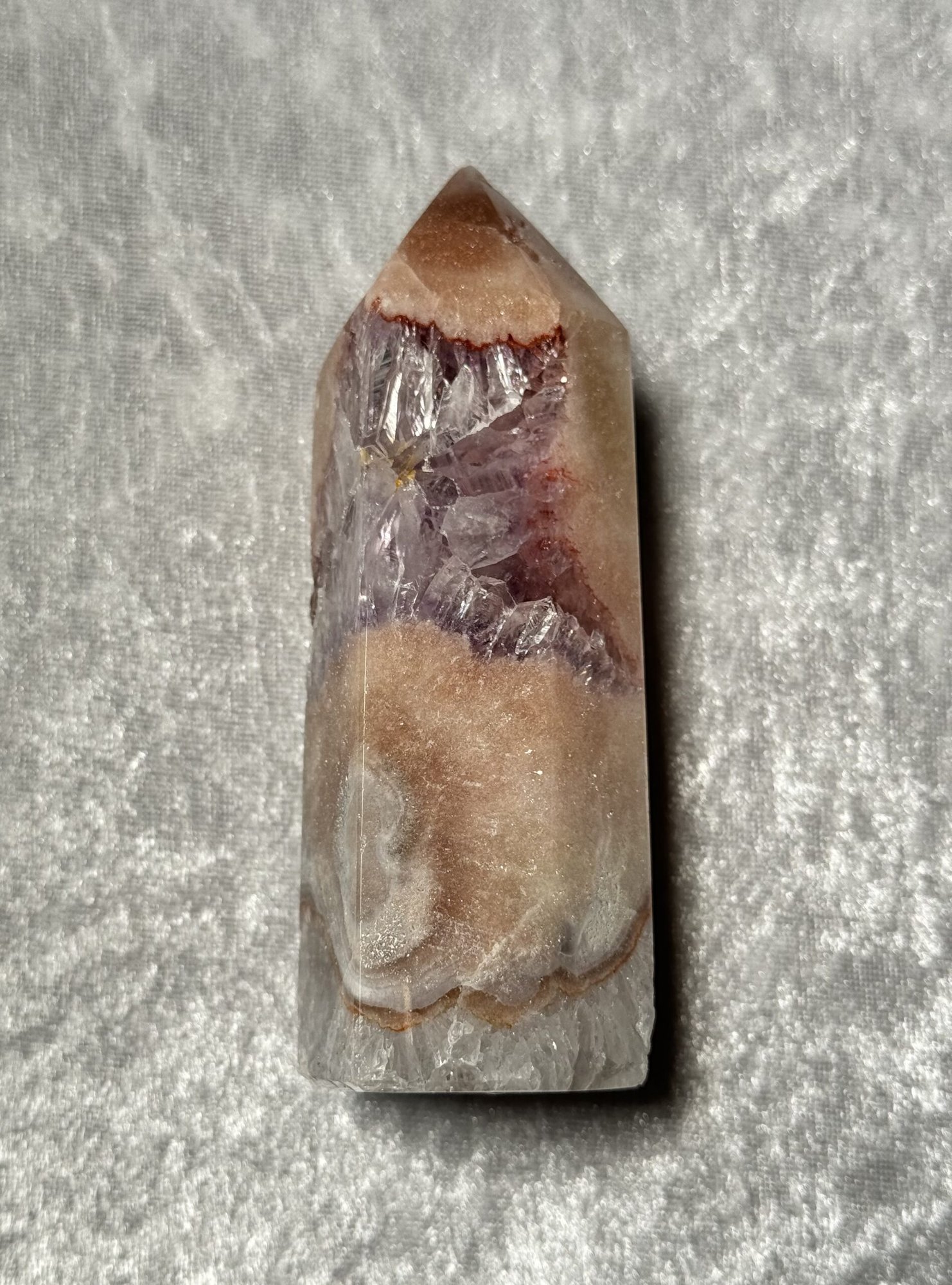
The material that became known as Pink Amethyst appeared on the mineral market relatively recently, with particularly well-studied specimens coming from the El Choique mine in Patagonia, Argentina.
Unlike ordinary Rose Quartz, it forms recognisable quartz crystals lining cavities and geodes.
So Why Call it Pink Amethyst?
That’s where things get interesting.
Amethyst has traditionally been defined by its purple colour, so calling something pink amethyst sounds rather contradictory.
However, scientific analysis of the Patagonian material found that its colour has an important connection with the chemistry responsible for Amethyst.
The crystals contain an iron-related colour centre, with microscopic particles of hematite providing additional reddish-pink colouring.
In other words, we’re not simply looking at ordinary quartz stained pink, nor are we looking at Rose Quartz.
The researchers studying the El Choique material considered it sufficiently distinctive to describe it as Pink Amethyst.
Not everyone agrees with the name, though.
Some mineral collectors and geologists prefer simply to describe the material as pink or hematite-bearing quartz, because amethyst has historically referred specifically to purple quartz.
Is Pink Amethyst a Real Mineral?
This is an important distinction.
Pink Amethyst isn’t a separate mineral species.
Chemically, it is still quartz — silicon dioxide (SiO₂).
“Pink Amethyst” is a name used to distinguish this unusual pink crystalline quartz from both traditional purple Amethyst and the other forms of pink quartz we’ve explored in this article.
And perhaps that’s why this material causes so much confusion.
Put Rose Quartz, Pink Quartz and Pink Amethyst beside one another and they may all be pink — and they’re all quartz.
But look beneath the colour and three very different stories begin to emerge.
At a Glance: Rose Quartz, Pink Quartz & Pink Amethyst
| Rose Quartz | Pink Quartz | Pink Amethyst | |
|---|---|---|---|
| What is it? | A familiar pink variety of quartz | Rare crystallised pink quartz | Pink crystalline quartz commonly sold as Pink Amethyst |
| Typical formation | Usually massive, without obvious individual crystal faces | Forms recognisable individual quartz crystals | Forms recognisable crystals, often lining cavities and geodes |
| Why is it pink? | Microscopic pink fibrous inclusions related to dumortierite | Irradiation-induced colour centres within the quartz structure | Iron-related colour centres, with microscopic hematite contributing additional pink-red colour |
| Light sensitive? | Generally considered relatively colour stable | Yes — can fade significantly with strong light or UV exposure | Colour stability can vary; prolonged strong sunlight is best avoided |
| Mineral | Quartz – SiO₂ | Quartz – SiO₂ | Quartz – SiO₂ |
| Interesting fact | Some specimens display a six-rayed star called asterism | Much rarer than ordinary massive Rose Quartz | “Pink Amethyst” is not a separate mineral species and the name itself is debated |
The simplest way to remember it: all three are quartz, and all three can be pink — but why they’re pink and how they grow tell very different geological stories.
Pink Quartz at The Crystal Tree
These beautiful Pink Quartz specimens have now found new homes, but we’ve kept this original video in the article because it gives a lovely close-up look at just how unusual crystallised Pink Quartz can be.
Rare pieces like these don’t come along very often, which makes it all the more special when we’re fortunate enough to find them.
Here some others blog posts for you
SHUNGITE

Ascension v Integration
