
SHUNGITE

Shungite – An Ancient Carbon-Rich Rock with a Remarkable Story
Some of Earth’s most remarkable treasures sparkle with colour. Shungite does the opposite.
At first glance, it can look rather ordinary: black, sometimes dusty, and without the crystal faces or flashes of colour that usually catch our eye. But Shungite has a story stretching back around two billion years, and its unusual carbon-rich composition has attracted the attention of geologists, scientists and, much more recently, the metaphysical world.
It has also become surrounded by some extraordinary claims.
So what actually is Shungite? Why is a black rock from a small part of Russia so unusual? And how did we get from an ancient geological material to claims about water purification, healing and protection from modern technology?
Let’s take a closer look.
Earth’s Hidden Treasures Journal
Approx. reading time: 8 minutes
In this article
- What is Shungite?
- Where is Shungite found?
- How did Shungite form?
- What makes Shungite unusual?
- What is Elite Shungite?
- Shungite through history
- How Did This Belief Begin?
- What does science actually tell us?
- Shungite at The Crystal Tree
- Quick Facts
Topics covered: Geology • Carbon • Karelia • History • Science & Folklore
What is Shungite?
Shungite is unusual because it isn’t a crystal in the way that quartz, fluorite or calcite are crystals.
It is a carbon-rich rock, containing carbon alongside varying amounts of other minerals. Its appearance can range from matt black and slightly earthy to the much rarer, silvery and almost metallic-looking material commonly sold as Elite Shungite.
The name comes from the village of Shunga in Karelia, north-west Russia, close to Lake Onega. This region contains enormous deposits of Shungite-bearing rock and is the place most closely associated with Shungite today.
And it is very old.
The rocks containing Shungite date to roughly two billion years ago, taking us back to a time when Earth looked very different from the planet we know today.
Where is Shungite Found?
Shungite is most famously associated with the Republic of Karelia in north-west Russia, particularly the area surrounding Lake Onega.
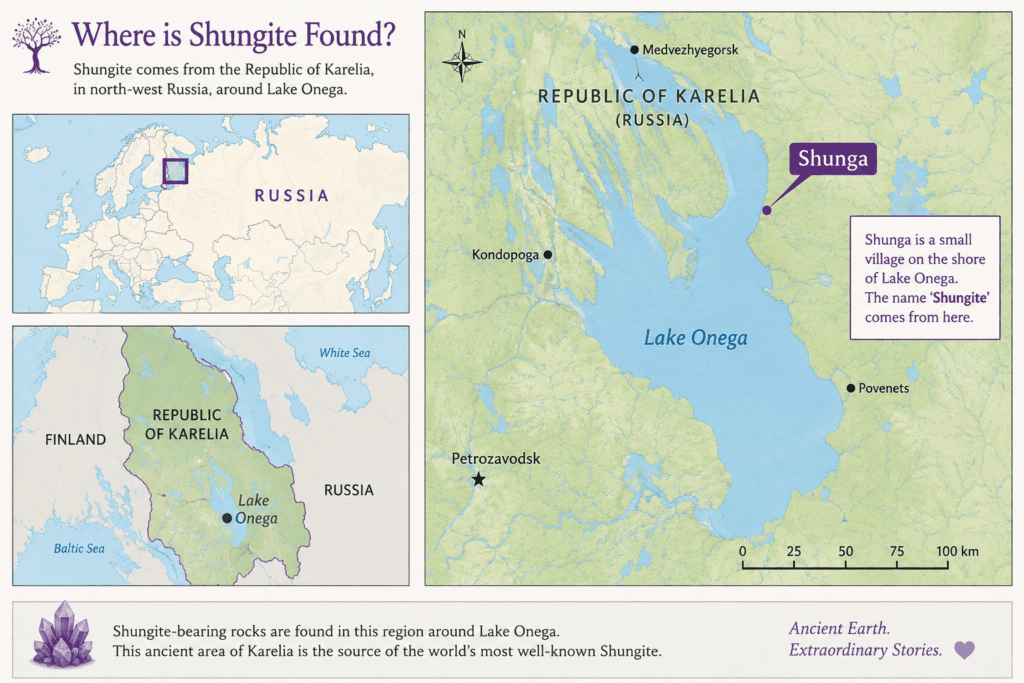
Although carbon-rich rocks occur elsewhere in the world, the extensive deposits in Karelia are geologically unusual, and the name Shungite has become particularly associated with material from this region.
Its connection to one relatively small part of the world is an important part of its story – and would eventually help turn a curious geological material into something surrounded by centuries of folklore.
How Did Shungite Form?
This is where the story becomes a little less certain.
Scientists know that the Shungite-bearing rocks of Karelia are incredibly ancient, but exactly how their extraordinary concentration of carbon originated has been debated.
Current geological thinking generally points towards ancient organic material as the original source of much of the carbon. Around two billion years ago, primitive life already existed in Earth’s oceans. Organic-rich material accumulated in sediments and, over immense periods of geological change, heat and pressure transformed that carbon along with the surrounding rocks.
The result was something very unusual.
Not coal.
Not graphite.
Not a crystal.
Shungite.
And although scientists have learned a great deal about it, its complicated geological history means there are still questions to explore.
What Makes Shungite So Unusual?
The obvious answer is carbon.
Different Shungite rocks contain very different amounts of it. Some contain relatively little, while the rarest material can be extremely carbon-rich.
But the structure of that carbon is particularly interesting.
Research into Shungite has found naturally occurring forms of disordered carbon with unusual structural and electrical properties. This has led scientists to investigate possible technological uses for Shungite-derived materials, including electrical conductivity and electromagnetic shielding.
You may also have heard Shungite mentioned alongside fullerenes.
Fullerenes are remarkable arrangements of carbon atoms that can form hollow, cage-like structures. Research into the exact nature of Shungite’s carbon has developed considerably over the years, however, so the often-repeated description of Shungite simply as a rock “full of fullerenes” is an oversimplification.
The real science is more complicated – but also far more interesting.
What is Elite Shungite?
If you’ve seen both ordinary Shungite and Elite Shungite, you could easily wonder whether they’re the same material.
They are – but their carbon content and appearance can be very different.
The Shungite most commonly carved into spheres, pyramids and other shapes is black with a matt to softly polished surface.
Elite Shungite, sometimes called Noble Shungite, is much rarer and considerably richer in carbon. Rather than looking like an ordinary black rock, it often has a silvery, metallic lustre and irregular natural fractures.
Only a small proportion of Shungite occurs in this highly carbon-rich form, which is why Elite Shungite is generally sold as natural fragments rather than large polished carvings.
Shungite Through History
Long before anyone was discussing Wi-Fi or electromagnetic fields, Shungite had already developed an interesting reputation.
One of the most famous chapters in its history involves Peter the Great, Tsar of Russia.
In the early eighteenth century, Peter became interested in mineral springs in Karelia whose waters had acquired a reputation for their supposed health-giving qualities. He later established Marcial Waters, regarded as Russia’s first spa, in the region.
The local water and Shungite-bearing geology subsequently became closely connected in popular accounts of Shungite’s history.
And this is where things become particularly interesting.
Because when a natural material has been associated with health and unusual water for hundreds of years, it isn’t difficult to see how later generations might begin adding new ideas to the story.
How Did This Belief Begin?
This is a question we think is worth asking whenever a crystal or mineral becomes surrounded by extraordinary claims.
Rather than simply asking “Is it true?”, sometimes it is much more interesting to ask:
Where did the idea come from?
In Shungite’s case, there wasn’t one single moment.
Its long association with the waters of Karelia provided an historical foundation. Stories surrounding Peter the Great added another layer. Later, scientific research discovered genuinely interesting properties within Shungite’s carbon.
Then came the modern wellness and crystal movements.
Over time, very different pieces of information became blended together.
Shungite began to be described as purifying, detoxifying and healing. More recently, one particular claim has become especially widespread: that keeping Shungite near phones, computers or Wi-Fi routers can protect people from electromagnetic fields (EMFs).
And here’s where an important distinction gets lost.
What Does Science Actually Tell Us?
There is genuine scientific research into carbon-rich Shungite materials and electromagnetic radiation.
Researchers have studied Shungite-derived carbon for its electrical properties and its potential use in engineered electromagnetic shielding materials. That science is real and potentially very useful.
But that isn’t the same as demonstrating that placing a Shungite pyramid beside a Wi-Fi router, carrying a stone in your pocket or wearing Shungite jewellery protects the human body from everyday electromagnetic fields.
At present, there isn’t good scientific evidence demonstrating that kind of personal protection.
It’s a wonderful example of how a claim can begin with a small piece of genuine science and gradually become something much bigger as it travels through books, websites and social media.
For us, that doesn’t make Shungite any less fascinating.
Quite the opposite.
Strip away the extraordinary claims and you’re still left with an ancient, unusual carbon-rich rock that has survived around two billion years of Earth’s history and continues to be studied today.
That’s remarkable enough.
Shungite at The Crystal Tree
We’ve stocked Shungite at The Crystal Tree for many years, from simple polished stones and jewellery to spheres, carvings and rare pieces of Elite Shungite.
Our understanding of it has changed over that time too.
Like many people within the crystal world, we first encountered Shungite alongside stories about its metaphysical properties. As we’ve learned more about geology and become increasingly interested in the evidence behind the stories attached to crystals, we’ve found the real story of Shungite far more interesting.
Today, we’d rather share what we know, explain where some of the beliefs may have come from, and allow you to decide what Shungite means to you.
After all, a piece of Earth’s history doesn’t need an extraordinary claim attached to it to be extraordinary.
Quick Facts
Name: Shungite
Type: Carbon-rich rock
Age: Approximately 2 billion years
Colour: Black to silvery black
Main Location: Karelia, north-west Russia
Named After: Shunga, a settlement in Karelia
Composition: Carbon-rich material mixed with varying proportions of other minerals
Elite Shungite: A rare, particularly carbon-rich variety with a distinctive silvery appearance
Interesting Fact: Shungite continues to be studied for the unusual physical and electrical properties of its carbon.
Continue Exploring Earth’s Hidden Treasures
If you’ve enjoyed discovering the story behind Shungite, why not continue exploring Earth’s Hidden Treasures through our Crystal Library?
Visit our Crystal Library to discover more remarkable minerals and rocks, their geology, history and the stories that have grown around them.
Further Reading
The Geology of Karelian Shungite
For readers interested in going deeper into the geology, this scientific review explores the ancient Shungite-bearing rocks around Lake Onega, their carbon content and how they may have formed.
Read the Earth-Science Reviews paper
Peter the Great and Marcial Waters
The National Museum of the Republic of Karelia tells the history of Marcial Waters, Russia’s first health resort, and Peter the Great’s connection with the springs.
Visit the Marcial Waters Museum
The Unusual Carbon in Shungite
This scientific study looks at the structure of carbon found within Shungite and compares it with other naturally occurring forms of carbon.
Read the research in Carbon
Here some others blog posts for you

Birthstones – Who Decided Which Stone Belongs to Each Month?
Celebrating International Rock Day: The Stories Hidden in Stone
