RARE Pink Quartz vs Rose Quartz! And what is Pink Amethyst!

RARE Pink Quartz vs Rose Quartz! And what is Pink Amethyst!
Every day we learn something new, it keeps us passionate about what we do here at The Crystal Tree. We have to rely on our suppliers for information about where our crystals come from, but sometimes they get it wrong! Therefore we get it wrong. So lets put wrong a right.
Rose quartz always occurs in massive form without crystal faces or terminations. ‘Massive’ isn’t a reference to the size of the specimen, rather the formation of the crystals. Massive specimens have no or very little discernible crystal structure – most Rose Quartz occurs as a rough block with no ‘form’ to it.

Mineralogists had traditionally attributed the colour of rose quartz to traces of titanium and, to a lesser extent, iron and manganese. These impurities were thought to distort the crystal lattice, causing it to reflect and transmit red wavelengths of light which the human eye perceives as varying shades of pink.
More recent studies have shown the pink colour is because of fibrous inclusions. After dissolving rose quartz from several different sources in hydrofluoric acid, researchers have recovered residues of flaky, pink-coloured nanofibers, most consisting of dumortierite and other aluminium borosilicates.
Although these nanofibers make up only about one-tenth of one percent of the overall weight of rose quartz, they are highly reflective and create both its characteristic pink colour and its soft translucency. Usually aligned along the axes of quartz’s hexagonal crystals, these inclusions also explain the six-rayed asterism that appears in the star variety of rose quartz.
Pink quartz, a pink macro-crystalline variety of quartz, was initially assumed to be a rare, atypical sub-variety of rose quartz. Pink Quartz has a euhedral formation, meaning it forms with easily recognised crystal faces.
The colour of pink quartz is likely due to a combination of factors involving aluminium and phosphorus replacing silicon in the quartz structure and exposure to natural gamma radiation. This gamma radiation irradiates the quartz, leading to the development of its pink colour.
This process is distinct from the colouration process in rose quartz, making pink quartz unique in its formation and appearance.
Pink quartz gets its colour from irradiated aluminium and phosphorus inclusions within the crystal lattice. This is a similar mechanism to how amethyst gets its purple colour. It leads to pink quartz having some different properties than rose quartz such as being light sensitive. Similar to amethyst, pink quartz will fade over time when exposed to sunlight, while rose quartz is colour stable and will not fade due to sunlight exposure.
To summarise…Pink quartz and rose quartz differ in a number of properties
– the cause of their colour is not the same,
– pink quartz is sensitive to light, while rose quartz is not
– both varieties form in different environments, and
– pink quartz develops crystals while rose quartz does not.
Pink Amethyst is neither rose quartz or pink quartz. Both traditional amethyst (purple variety) and pink amethyst get their colours from iron. The type of iron and how it’s included in the crystals differ for each.
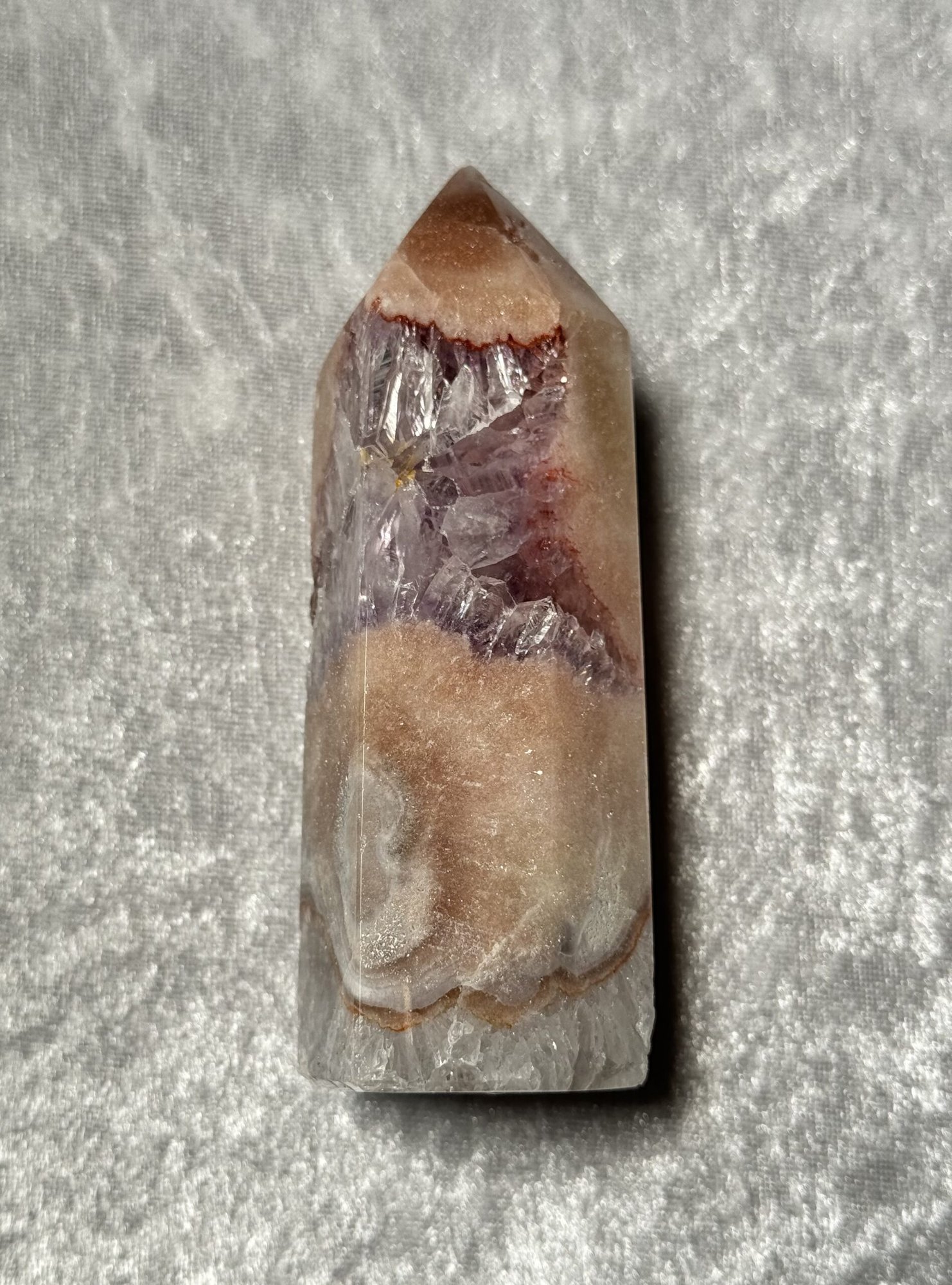
When a chemical analysis was performed on the pink amethyst crystals, they were found to contain microscopic hematite particles, and other micro calcium and sulphate inclusions. Purple amethyst colour is not caused by any inclusions, it is caused by gamma irradiation that causes a colour shift in the atoms of trace amounts of iron in the crystal lattice work.
In Summary
| Name | How it gets its colour | Formation |
| Rose quartz | Pink fibrous inclusions | Anhedral |
| Pink quartz | Aluminium and phosphorous activated by gamma radiation | Euhedral |
| Pink amethyst | Iron activated by gamma radiation and microscopic hematite inclusions | Euhedral |
Rare Pink Quartz (as of June 2024), please send a message if you are interested in either of these two pieces.
Here some others blog posts for you
Ascension v Integration
Why I Stopped Teaching Crystal Healing